



News
Scarborough Shoal: China's Dangerous Bet in the South China Sea
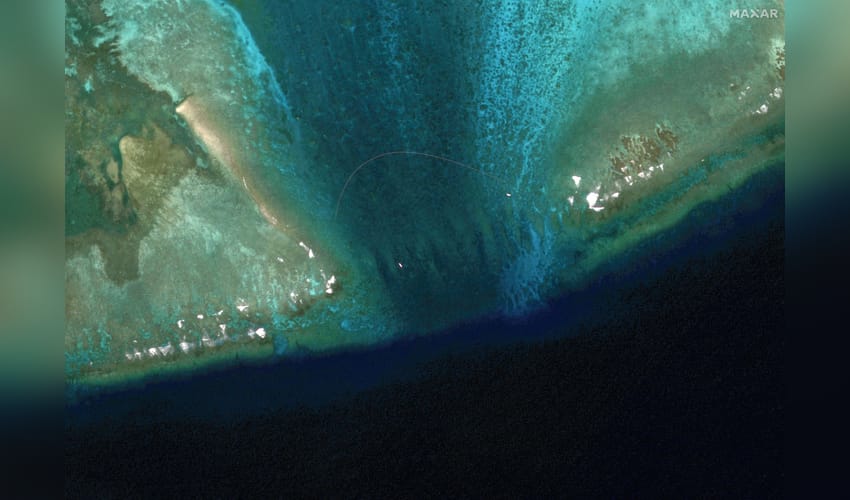

China’s ambitions in the Indo-Pacific are no longer hidden behind diplomatic language. They are visible in the water cannons, floating barriers, coast guard blockades, military patrols, and legal tricks used to turn disputed waters into controlled territory. At the heart of this pressure campaign is Scarborough Shoal, a small reef west of Luzon that has become one of the most dangerous flashpoints in Asia.
Scarborough Shoal, known in the Philippines as Bajo de Masinloc and in China as Huangyan Dao, lies about 120 nautical miles west of Luzon, well within the 200-nautical-mile zone where a coastal state enjoys sovereign rights over resources under the UN Convention on the Law of the Sea. Yet Beijing treats the shoal not as a legal question, but as a test of power.
China claims “indisputable sovereignty” over Scarborough Shoal and its adjacent waters. In November 2024, Beijing went further by declaring territorial sea baselines around the shoal, a move the Philippines formally rejected. This is part of a wider Chinese method: first assert a historical claim, then patrol it, then regulate it, then normalize control.
The problem is that international law does not support China’s sweeping South China Sea position. In 2016, an arbitral tribunal constituted under UNCLOS ruled that China’s claims to “historic rights” inside the nine-dash line had no legal basis where they exceeded maritime entitlements allowed by the Convention. The tribunal also found that Scarborough Shoal is a rock, not an island capable of generating its own exclusive economic zone or continental shelf.
To be clear, the tribunal did not decide who owns Scarborough Shoal as sovereign territory. But it did reject the legal foundation of China’s vast maritime claims, and it criticized actions that prevented Filipino fishermen from accessing traditional fishing grounds. That is why the ruling matters: it separates lawful maritime rights from raw coercion.
Scarborough Shoal became a symbol of this coercion after the 2012 standoff between China and the Philippines. Since then, China has maintained effective control through constant coast guard presence. CSIS’s Asia Maritime Transparency Initiative notes that there are no built structures on the shoal itself, but China has kept a persistent coast guard presence there since 2012.
What makes Scarborough so important is geography. It sits near Luzon, near major sea lanes, and close to the northern approaches of the South China Sea. For the Philippines, it is about fishermen, sovereignty, food security, and national dignity. For China, it is a forward position from which it can pressure Manila, monitor U.S.-Philippine activity, and deepen its reach toward the wider Pacific.
This is why recent developments are alarming. In 2024 and 2025, confrontations near Scarborough Shoal intensified, with Chinese coast guard vessels using water cannons, blocking maneuvers, and patrol pressure against Philippine vessels. CSIS tracking showed Chinese law-enforcement presence around Scarborough consistently exceeded that of the Philippines from August 2024 to May 2025, with frequent vessel interactions around the shoal.
Then came a sharper legal and administrative push. In September 2025, China approved a “national nature reserve” at Scarborough Shoal. Beijing presented it as environmental protection. Manila saw it as another tool to justify occupation and control. This is classic lawfare: dress expansion as regulation, then accuse others of violating rules you created unilaterally.
By 2026, the situation had moved from dangerous to potentially explosive. Reuters reported satellite imagery showing China using ships and a barrier to tighten control around the entrance of Scarborough Shoal. Soon after, the Philippines investigated reports of a possible new structure or floating platform at the shoal. Manila urged China to remove it, warning that it would not allow the site to be turned into a man-made island.
That warning carries historical weight. China’s record in the South China Sea shows how “temporary” or “civilian” activity can become permanent strategic infrastructure. Mischief Reef, once a disputed feature, was transformed into a major Chinese artificial island with military facilities. For Manila, the fear is simple: Scarborough could become the next step in China’s island-building playbook.
China rejects this framing. It insists its activities are lawful and within its sovereignty. It also rejects the 2016 arbitral award, calling it illegal and non-binding. But repeating a claim does not make it legal. The modern maritime order is not built on ancient maps, coast guard intimidation, or the ability to outnumber smaller states at sea. It is built on treaty law, peaceful dispute settlement, and respect for the rights of coastal states.
This is why Scarborough Shoal remains relevant today. It is not just a reef. It is a test case for whether international law can restrain a major power. If China can convert pressure into control at Scarborough, the message to the region is clear: legal victories mean little unless backed by political will, maritime capacity, and international support.
For the Philippines, the stakes are immediate. Filipino fishermen have depended on these waters for generations. When Chinese vessels block access, the impact is not abstract geopolitics; it is lost income, fear at sea, and a daily reminder that a larger power can interfere with ordinary lives. That human dimension is often missing from strategic maps.
For Southeast Asia, the stakes are regional. Vietnam, Malaysia, Brunei, Indonesia, and others watch how China behaves toward the Philippines because similar tactics can be used elsewhere: patrol first, deny access second, create administrative rules third and then claim that foreign resistance is “provocation.”
For the United States and its allies, Scarborough is also a credibility test. Washington has repeatedly affirmed that its Mutual Defense Treaty with the Philippines applies to armed attacks on Philippine armed forces, public vessels, or aircraft, including in the South China Sea. That does not mean war is inevitable. But it does mean reckless encounters around Scarborough carry alliance consequences.
China’s strategy depends on staying below the threshold of open conflict while steadily changing facts on the water. That is why coast guard ships, maritime militia, floating barriers, “research” platforms, and environmental declarations matter. Each move may appear small. Together, they build control.
The answer cannot be panic, but it also cannot be silence. The Philippines must continue documenting incidents, strengthening coast guard capability, supporting fishermen, and keeping disputes anchored in UNCLOS. ASEAN must stop treating the South China Sea as a side issue. Democratic partners must help Manila with surveillance, maritime domain awareness, legal support and diplomatic backing.
Scarborough Shoal shows the Indo-Pacific’s central question in miniature: will the region be governed by law, or by the strongest navy in the water? China wants the world to accept its control as normal. The Philippines is refusing to do so. That refusal matters, because if Scarborough falls quietly into permanent coercive control, the next flashpoint will not be far behind.
Disclaimer: This image is taken from Reuters.