



World
Iran Warns Saudi Arabia Over Turkey-Pakistan Defence Pact, Says 'Paper Agreement' Won't Ensure Security
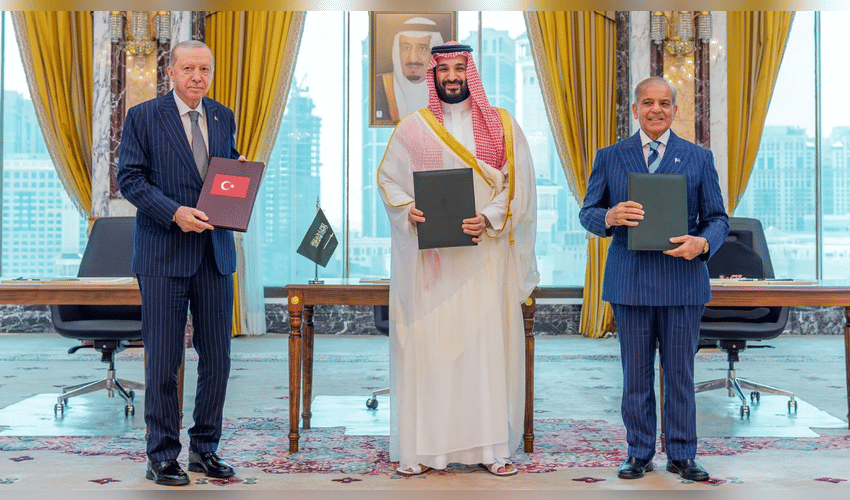

Iran has criticised Saudi Arabia’s new defence agreement with Türkiye and Pakistan, warning that the pact will not be enough to guarantee the kingdom’s security. The reaction came after Saudi Arabia, Türkiye and Pakistan signed a strategic mutual defence agreement in Mecca on August 7. The agreement states that an armed attack against any one of the three countries will be considered an attack against all three, strengthening military cooperation among the partners.
Iranian lawmaker Ebrahim Rezaei, a member of the Iranian Parliament’s National Security and Foreign Policy Commission, criticised the agreement and questioned Saudi Arabia’s decision to seek security through military partnerships. According to reports, Rezaei said Saudi Arabia should not expect security from what he described as agreements on paper. He also pointed to Riyadh’s long-standing security relationship with the United States, arguing that dependence on foreign powers had not provided the level of security Saudi Arabia expected.
The Iranian remarks came as the new Saudi-Türkiye-Pakistan pact attracted attention across the region. The agreement brings together three countries with significant military and strategic capabilities. Saudi Arabia has invested heavily in defence modernisation, Türkiye has emerged as an important defence technology producer, particularly in drones and other military systems, while Pakistan has one of the region’s largest armed forces and is a nuclear-armed country.
The agreement is being seen as a significant development in the security relationship between the three nations. Saudi Arabia and Pakistan already maintain close military ties, while Riyadh and Ankara have expanded their strategic relationship in recent years. The new pact comes at a time of heightened tensions in the Middle East and could influence the region’s evolving security calculations. Although the three countries have presented the agreement as defensive in nature, its collective-defence provision has drawn attention because of the wider geopolitical tensions involving Iran and other regional powers.
Iran and Saudi Arabia restored diplomatic relations in 2023 after years of rivalry, raising hopes that tensions between the two regional powers would ease. The broader security situation in the Middle East has remained volatile, with conflicts and military confrontations continuing to affect relations between regional countries. For Saudi Arabia, the agreement with Türkiye and Pakistan provides another layer of security cooperation as Riyadh seeks to strengthen its strategic partnerships. For Pakistan and Türkiye, the pact offers an opportunity to deepen their defence and security roles in the Gulf.
Iran’s latest criticism indicates that Tehran is closely monitoring the growing military cooperation around Saudi Arabia. Whether the new agreement develops into a deeper defence partnership or primarily serves as a deterrence mechanism will depend on how the three countries implement it in the months ahead. The pact has nevertheless added a new dimension to the Middle East’s increasingly complicated security environment, with Iran making clear that it does not believe external defence agreements alone can guarantee Saudi Arabia’s long-term security.



