



Military
IAF Highlights Indigenous Innovation and Collaboration to Boost India's Aerospace Strength
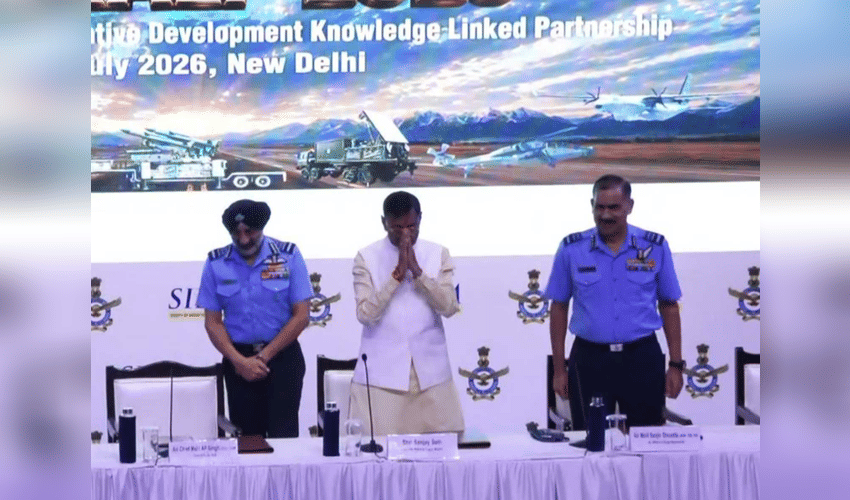

Air Marshal Sanjiv Ghuratia, Officer-in-Charge (Maintenance) of the Indian Air Force (IAF), on Thursday underscored the need for stronger collaboration among the armed forces, defence manufacturers, research institutions and certification agencies to accelerate the development of a self-reliant aerospace ecosystem in India.
Speaking at a workshop jointly organised by the IAF and the Society of Indian Defence Manufacturers (SIDM), Air Marshal Ghuratia said India's future aerospace ambitions can only be realised through collective effort rather than isolated initiatives. He stressed that cooperation, knowledge exchange, mutual trust and a shared national vision are essential for achieving long-term progress.
He also thanked the Minister of State for Defence for supporting policies aimed at expanding India's indigenous defence manufacturing capabilities. According to him, these initiatives are playing a vital role in turning the vision of Aatmanirbhar Bharat into practical defence capabilities. Referring to the seminar's theme, 'Sankalp', Air Marshal Ghuratia described it as a symbol of determination and collective commitment towards self-reliance, indigenous innovation and collaborative knowledge-sharing—key pillars for India's aerospace future.
He emphasised that achieving self-sufficiency in defence requires homegrown technological development, which in turn depends on close partnerships between industry, academia, research organisations, certification bodies and the armed forces. Highlighting the evolving nature of modern warfare, he pointed to emerging technologies such as artificial intelligence (AI), predictive maintenance, quantum technologies and cyber resilience as transformative forces shaping future military operations.
Air Marshal Ghuratia warned that excessive dependence on foreign supply chains for critical defence technologies creates strategic vulnerabilities. He noted that developing indigenous aerospace capabilities is no longer just an economic objective but a crucial national security priority. Drawing inspiration from the Shrimad Bhagavad Gita, he said that excellence in one's duty continues to guide the Indian Air Force, where operational readiness, engineering precision and continuous innovation remain core values.
While acknowledging the significant progress India's defence manufacturing sector has made over the past decade, he said the country still has work to do before achieving complete technological independence. He also remarked that strategic technologies cannot always be assessed purely through commercial or market-driven metrics. Certain capabilities, he said, must be developed because they are vital to safeguarding national interests, regardless of immediate economic returns.
Concluding his address, Air Marshal Ghuratia noted that major aerospace achievements around the world have been possible when governments, defence forces, industry and research organisations worked together towards common strategic goals. He expressed confidence that India already possesses the necessary talent, infrastructure and institutional strength, adding that the next step is to integrate these capabilities into a unified framework to achieve true technological sovereignty.



