



Politics
Delimitation Explained: How 20 Rebel TMC MPs and 22 DMK Lawmakers Could Shape the Lok Sabha Numbers Game
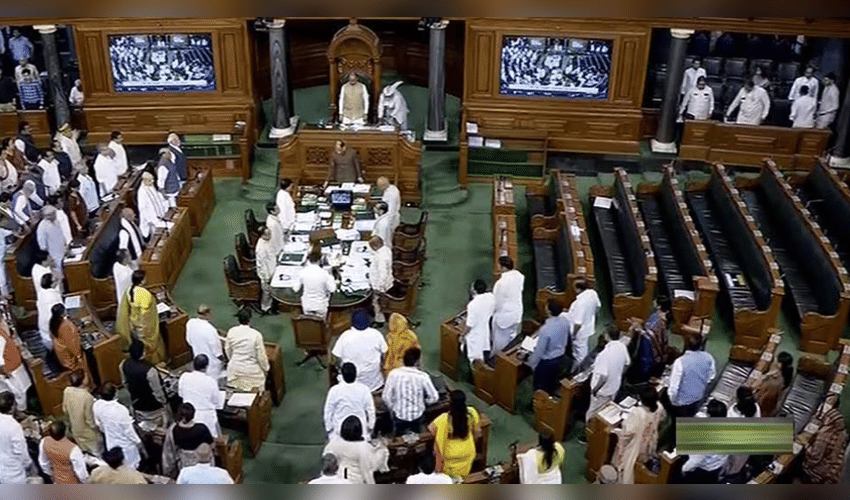

The BJP-led National Democratic Alliance (NDA) is facing a challenging numbers game in Parliament as the government prepares to move ahead with its proposed delimitation exercise and women's reservation legislation. The positions of 20 rebel Trinamool Congress (TMC) MPs and 22 Dravida Munnetra Kazhagam (DMK) lawmakers could prove crucial in determining whether the proposed constitutional amendment secures the required parliamentary support.
The delimitation debate has gained political momentum amid discussions about increasing the strength of the Lok Sabha and implementing 33 per cent reservation for women in Parliament and state legislative assemblies. However, the government's proposal has also triggered concerns over the redistribution of parliamentary constituencies and its possible impact on the political representation of southern states.
The 20 MPs who broke away from the TMC have become an important part of the NDA's calculations. Their political realignment could strengthen the ruling alliance's position, although the matter remains complicated by the ongoing dispute over their parliamentary membership. The TMC has challenged the rebel lawmakers' move and sought their disqualification under the anti-defection law. The final decision by the Lok Sabha Speaker could have implications for the government's voting strategy.
The DMK's 22 MPs could play a significant role in the outcome. The Tamil Nadu-based party has expressed concerns that a population-based delimitation exercise could reduce the relative representation of southern states in Parliament. States such as Tamil Nadu, Kerala, Karnataka, Andhra Pradesh and Telangana fear that their efforts to control population growth could leave them with a smaller share of parliamentary influence compared with states experiencing higher population growth.
The government has considered a proposal to increase the number of parliamentary seats across states while retaining their existing relative share. The proposed arrangement is intended to expand representation without significantly changing the balance between states. However, regional parties are likely to examine the final legislative provisions before deciding whether to support the proposal.
The government's biggest challenge remains securing the special majority required to pass a constitutional amendment. Under Article 368 of the Constitution, an amendment must receive the support of a majority of the House's total membership and at least two-thirds of members present and voting. With three vacancies, the Lok Sabha currently has 540 members, meaning the government would need 360 votes if all members participate in the voting process.
The NDA's estimated strength of around 320 MPs leaves it dependent on additional support from regional parties, smaller political groups and independent lawmakers. The voting calculation could change if opposition MPs abstain or remain absent, as the two-thirds requirement is determined by the number of members present and voting. The separate requirement of a majority of the House's total membership must also be fulfilled.
The Rajya Sabha presents another challenge for the government, as the constitutional amendment will need to secure the required special majority in the Upper House as well. Depending on the final provisions, ratification by at least half of the state legislatures may also be necessary under the Constitution. Opposition parties have questioned the government's decision to link women's reservation with delimitation, arguing that the reservation policy should not be delayed by constituency redistribution. The government, meanwhile, maintains that expanding parliamentary representation is necessary to accommodate the proposed changes.
With the 2029 general election approaching, the delimitation exercise has become an important political and constitutional issue. The position of the 20 rebel TMC MPs, the DMK's 22 lawmakers and other regional parties could influence the government's ability to secure the necessary votes. Beyond the immediate parliamentary arithmetic, the larger challenge will be finding a formula that expands representation while maintaining a fair balance between India's states.
Disclaimer: This image is taken from PTI.