



Military
Russia unveils an upgraded Su-57 as India hunts for 5th-gen jets.
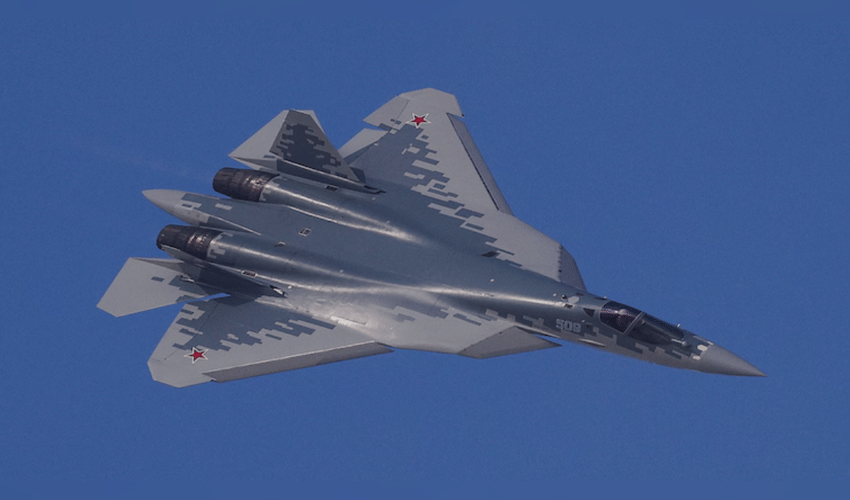

Russia has unveiled an upgraded Sukhoi Su-57 fifth-generation stealth fighter as India steps up its search for advanced aircraft to strengthen its air capabilities. Moscow is expected to offer India a highly enhanced Su-57 with full technology transfer (ToT) as the Indian Air Force (IAF) seeks stealth fighters.
State-owned ROSTEC stated that the latest Su-57s feature advanced onboard systems and a revamped weapons suite, boosting operational versatility. A Su-57 pilot noted that the aircraft meet Russia’s Defence Ministry standards and have already proven themselves in ongoing military operations. Upgrades expand mission profiles, enabling new weapon types and increased adaptability across combat scenarios.
The Su-57 is a multi-role fighter capable of striking air, ground, and naval targets in all-weather conditions, even under electronic warfare. Its stealth and supermaneuverability distinguish it in modern air combat. Vadim Badekha, CEO of United Aircraft Corporation (UAC), highlighted ongoing improvements in avionics and armaments, emphasizing the jet’s efficiency and combat effectiveness.
The rollout aligns with Russia’s push to engage India on the Su-57, including full ToT and local production. At the Dubai Air Show, Moscow offered a comprehensive package addressing all Indian requirements. Proposals include initial deliveries from Russia, phased manufacturing in India, licensed munitions production, and mastery of next-gen technologies like engines, AESA radars, AI integration, low observables, and advanced weaponry. Russia may also develop a twin-seat variant tailored for India, prioritizing indigenous production to reduce sanction risks and support India’s Atmanirbhar Bharat initiative.
For India, the timing is crucial. Under Roadmap 2047, the IAF needs 35–40 new fighters annually for the next two decades to maintain squadron strength. Indigenous projects like AMCA are progressing, but foreign acquisitions remain vital amid threats from China and Pakistan. Current IAF strength stands at roughly 30 squadrons versus an authorized 42, with delays in projects like Tejas Mk-2 and Rafale deliveries worsening the gap.
Defence cooperation is expected to be a key topic in the upcoming Modi-Putin summit, covering Su-57 collaboration, S-400 and S-500 developments, Su-30MKI and T-90 co-production, and BrahMos enhancements. India’s Su-57 evaluation draws on the previous FGFA project, abandoned in 2018 over cost and tech concerns. New upgrades—advanced engines, improved stealth, and AI features—could renew interest, with full ToT enabling HAL or private firms like TATA to assemble jets domestically.
Challenges remain, including unproven stealth in combat and engine reliability issues. Geopolitical factors, CAATSA waivers, and US-India defence ties also influence decisions. Still, Russia’s proven track record as a supplier—from MiG-29s to S-400s—adds appeal. The Su-57 offers network-centric warfare integration, hypersonic weapons compatibility, drone swarm deployment, and potential for a two-seater variant for training or exports. Local production would generate jobs, strengthen the supply chain, and support exports under Make in India. As the IAF weighs the Su-57 against alternatives like the F-35 or Eurofighter, Russia’s offer stands out for cost-effectiveness and full ToT, bridging the gap until AMCA becomes operational around 2035.



