



Asia In News
'Renewed momentum': JP Nadda co-chairs 3rd India-Japan healthcare meet to boost cooperation.
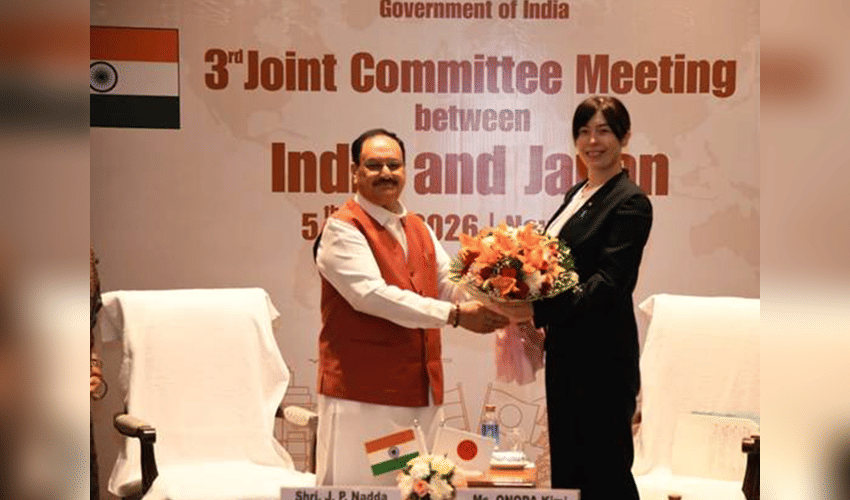

The 3rd Joint Committee Meeting (JCM) on Healthcare between India and Japan was convened on Tuesday at Bharat Mandapam in New Delhi. The session was co-chaired by Union Health Minister Jagat Prakash Nadda and Japan’s Minister in charge of Healthcare Policy, Kimi Onoda. Welcoming the Japanese delegation, Union Health Secretary Punya Salila Srivastava said that India and Japan share a relationship built on mutual trust, respect, and a common vision for the future. She added that the Joint Committee Meeting, conducted under the India–Japan Memorandum of Cooperation, has become an important platform for strengthening ties through continuous dialogue and deeper understanding, expressing hope for meaningful and forward-looking discussions.
Nadda stated that the meeting reflects the strong commitment of both nations to expand cooperation and build new partnerships in the healthcare sector. He noted that collaboration under the Memorandum of Cooperation on Healthcare and Wellness is guided by a shared goal of improving health systems, expanding access to care, and encouraging innovation for better outcomes.
He also highlighted the long-standing India–Japan relationship, which spans over a century, and reaffirmed India’s development approach based on “Sabka Saath, Sabka Vikas.” He described the Joint Committee Meeting as a key mechanism for advancing healthcare cooperation. Onoda emphasized Japan’s continued focus on strengthening healthcare collaboration through innovation, technology, and research, and expressed Japan’s willingness to further deepen ties.
The discussions covered major areas including prevention, diagnosis, treatment, and rehabilitation of non-communicable diseases (NCDs). India highlighted the rising burden of such diseases and its strategy focused on screening, continuous care, and health promotion aligned with the Sustainable Development Goals. Japan shared its initiatives in cancer screening, early detection, and improving treatment systems through technical and institutional cooperation.
On supply chain resilience and medical access, India emphasized its strong pharmaceutical and medical device manufacturing base, along with efforts to ensure affordability and reduce dependency through policy support. Japan outlined its public–private collaboration model aimed at improving access, strengthening supply chains, and enabling technology adoption.
In digital health, India presented its Ayushman Bharat Digital Mission, which supports an integrated, secure, and citizen-focused digital health ecosystem. Japan shared its progress in digital healthcare through AI-enabled systems, research, and digital integration. On human resource development, India highlighted its framework for building a skilled healthcare workforce through training, exchanges, and competency recognition. Japan detailed its ongoing cooperation in joint research and personnel exchange programs.
In his concluding remarks, Nadda said the discussions have added fresh momentum to India–Japan health cooperation and reaffirmed the shared commitment to strengthen collaboration in key areas. He added that the outcomes provide a strong base for future cooperation and reiterated India’s intent to work closely with Japan for tangible benefits to citizens of both countries. Onoda also reaffirmed Japan’s commitment to deepening the India–Japan Special Strategic and Global Partnership in healthcare. Both sides expressed confidence in further strengthening ties to improve health outcomes for their populations.



