



Asia In News
Jaishankar says the India-EU free trade agreement could transform and significantly strengthen the partnership.
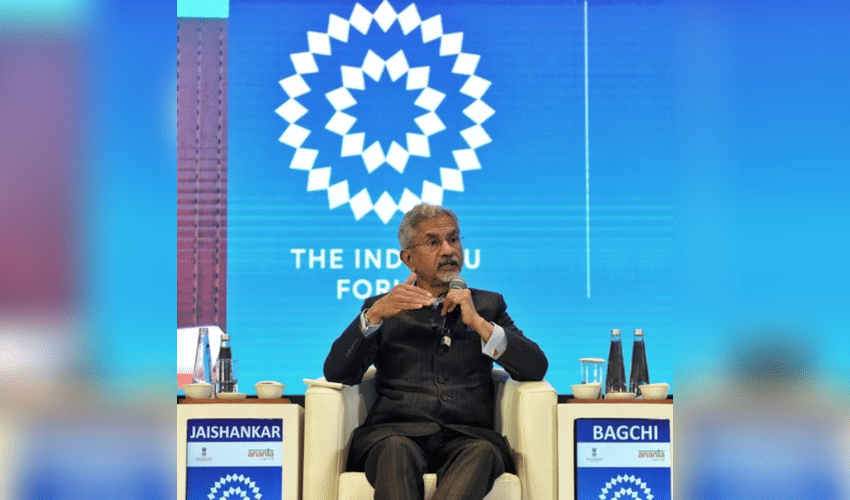

External Affairs Minister S. Jaishankar on Friday described the India–EU Free Trade Agreement (FTA) as a transformative step for bilateral ties while speaking at the inaugural India–EU Forum, organised by the Ananta Centre in collaboration with the Ministry of External Affairs. Jaishankar said he highlighted how the FTA has emerged as a “game-changing” development for India–EU relations, while also underlining other promising areas of cooperation such as security, defence, climate action, technology, and talent mobility. He added that he hoped the forum would encourage deeper dialogue and greater alignment between India and the European Union.
His remarks came shortly after India and the EU finalised and signed the landmark FTA on January 27, concluding long-running negotiations and marking a major milestone in one of India’s most important strategic economic partnerships. Framed as a modern, rules-based trade pact, the agreement addresses present-day global challenges and enables deeper market integration between the world’s fourth- and second-largest economies. With a combined market size of over Rs 2091.6 lakh crore (USD 24 trillion), the deal opens up new opportunities for nearly two billion people across India and the EU.
Under the FTA, more than 99 per cent of India’s exports by trade value will receive preferential market access, while India retains flexibility to protect sensitive sectors and uphold its development priorities. In 2024–25, bilateral merchandise trade stood at around Rs 11.5 lakh crore (USD 136.54 billion), with India exporting about Rs 6.4 lakh crore (USD 75.85 billion) to the EU. Services trade reached Rs 7.2 lakh crore (USD 83.10 billion).
Despite strong trade growth, both sides acknowledge significant untapped potential, which the FTA seeks to unlock by paving the way for India and the EU to become key economic partners. The agreement reshapes bilateral ties into a comprehensive, multi-dimensional partnership, offering predictability for exporters and enabling Indian companies, including MSMEs, to plan long-term investments and integrate into European value chains amid global uncertainty.
India has secured preferential access across 97 per cent of tariff lines, accounting for 99.5 per cent of trade value. Of these, 70.4 per cent of tariff lines covering 90.7 per cent of India’s exports will see immediate duty elimination in labour-intensive sectors such as textiles, leather and footwear, tea, coffee, spices, toys, sports goods, gems and jewellery, and select marine products. A further 20.3 per cent of tariff lines will be phased to zero duty within three to five years, while 6.1 per cent will receive tariff cuts or tariff rate quotas for products such as automobiles, steel, and certain shrimp and prawn items. Crucially, sectors currently facing EU duties ranging from 4 per cent to 26 per cent—together accounting for exports worth over Rs 2.87 lakh crore (USD 33 billion)—will gain zero-duty access from the date the agreement takes effect, sharply enhancing competitiveness.
In exchange, India will reduce or eliminate duties on 92.1 per cent of its tariff lines, covering 97.5 per cent of EU exports. Nearly half of these will see immediate duty elimination, while most of the remainder will be phased out over five, seven, or ten years. The FTA is expected to boost agriculture and processed food exports through preferential access for products such as tea, coffee, spices, grapes, gherkins, dried onion, and fresh fruits and vegetables, while carefully protecting sensitive areas like dairy, cereals, poultry, and soymeal.
Product-specific rules of origin are aligned with existing supply chains, allow self-certification, and provide special flexibilities for MSMEs, including quotas for shrimps, prawns, and downstream aluminium products. On services, the EU has made expanded commitments across 144 sub-sectors, including IT and IT-enabled services, professional services, education, and business services. India, in turn, has opened 102 sub-sectors covering EU priorities such as telecommunications, maritime, financial, and environmental services.
The agreement also creates a strong mobility framework for Indian professionals, covering intra-corporate transferees, contractual service suppliers, and independent professionals across multiple sub-sectors, along with commitments to finalise social security agreements within five years. Practitioners of traditional Indian medicine will gain improved access to provide AYUSH services in EU member states, with future provisions for wellness centres and clinics. The FTA strengthens intellectual property protections in line with TRIPS, recognises India’s Traditional Knowledge Digital Library, and enhances cooperation on sanitary, phytosanitary, and technical standards through digitisation and mutual recognition.
The deal is expected to deliver gains across engineering goods, marine products, leather and footwear, gems and jewellery, textiles, chemicals, plastics, medical devices, and minerals, driving exports, job creation, and investment. The India–EU FTA positions both sides as preferred economic partners and lays the groundwork for a resilient, future-ready partnership—an objective Jaishankar said the India–EU Forum aims to advance through deeper cooperation across strategic domains.



