



Military
From Sindoor to strategy, the Indian Army Chief has redefined national security as the cornerstone of economic and social prosperity.
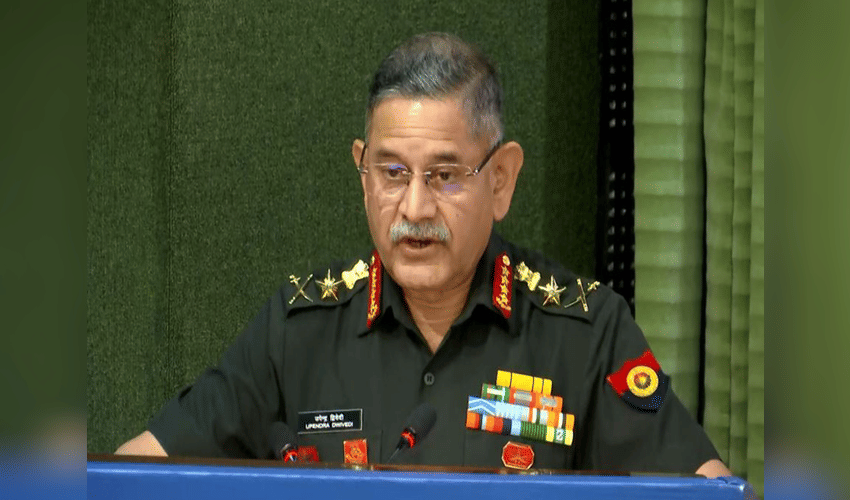

Indian Army Chief General Upendra Dwivedi, speaking on Tuesday at a seminar titled “Security to Prosperity” organized by the Centre for Land Warfare Studies (CLAWS), highlighted lessons from Operation Sindoor and presented a broader strategic outlook for India in an evolving global order. Referring to the recent operation, he called it a significant example of unified national action, combining military precision, information management, diplomatic messaging, and economic strength. He said it successfully targeted terror networks and challenged long-held strategic assumptions.
He particularly justified the 88-hour halt in hostilities, describing it as a deliberate and calculated use of “smart power” rather than a limitation. According to him, it reflected precise decision-making on when and how to transition from military action to strategic advantage. Discussing global geopolitics, he noted that earlier expectations of globalisation making war obsolete have proven wrong. Instead, economic systems, supply chains, and technology have become tools of geopolitical pressure. He pointed to semiconductors, contested maritime routes like the Strait of Hormuz, and rising global defence spending as evidence of intensifying power competition.
He argued that the world has shifted from a belief that prosperity reduces conflict to one where power is actively used to shape prosperity itself. Dwivedi stressed that security and economic growth are now deeply interconnected and cannot be treated separately. He stated that security is not just a support for prosperity but its essential starting point. For India, this means aligning national power to ensure peace, growth, and strategic advantage.
He also highlighted the rapid pace of technological change in warfare, noting that innovation cycles have shortened dramatically. He warned that delays in scaling new technologies make them strategically irrelevant. Calling for stronger integration across defence innovation systems, he urged the development of a robust ecosystem involving government, private industry, and academia, especially in areas like AI, cyber, quantum technology, space systems, autonomous platforms, and advanced materials.
He further identified dependence on foreign technology and supply chains as a major strategic weakness. According to him, future conflicts will be decided by whoever controls the technology ecosystem, making self-reliance in critical sectors essential. Concluding his address, he quoted Atal Bihari Vajpayee, emphasizing that peace comes from capability and resolve, not weakness. He ended by urging urgency, stating that while India is progressing, the key question is whether it is moving fast enough in a rapidly changing world.