



Military
Pakistan and Bangladesh Progress Toward a Mutual Defense Pact as Relations Strengthen
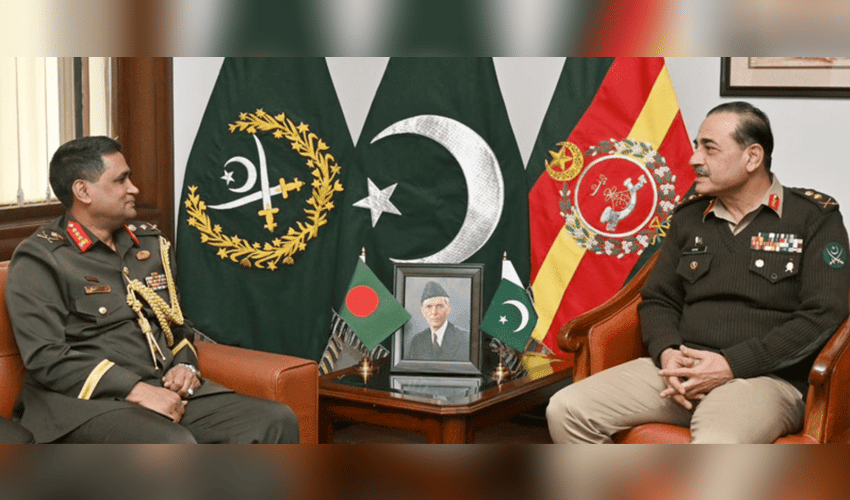

Pakistan and Bangladesh’s recent defence initiatives have raised concerns over India facing potential two-front security pressures. According to diplomatic and security sources, Islamabad and Dhaka have set up a joint mechanism including officials from their defence ministries and representatives from the army, navy, and air force.
The body is tasked with developing and evaluating a prospective defence pact, reminiscent of Pakistan’s longstanding military cooperation with Saudi Arabia. The proposed agreement would cover military collaboration, intelligence sharing, joint exercises, and coordinated crisis responses. Talks between the countries’ military leadership have progressed to drafting a formal accord, with final approval expected after Bangladesh’s general elections in February, allowing the new government to endorse it.
Indian security analysts view this as a possible reshaping of South Asia’s strategic environment, reopening concerns about simultaneous threats from Pakistan in the west and Bangladesh in the east. While India routinely plans for a two-front scenario involving Pakistan and China, the addition of an eastern axis would demand more resources and heightened vigilance. Historical conflicts, including the wars of 1948, 1965, and 1971, illustrate the challenges of managing threats on both borders. The 1971 war led to Bangladesh’s creation, seemingly neutralizing India’s eastern frontier, making a potential Pakistan-Bangladesh military alignment a significant shift.
Despite India’s overwhelming advantage—1.45 million active troops compared to Pakistan’s 650,000 and Bangladesh’s 150,000, alongside superior air and naval power—the challenge lies in managing multiple fronts, rather than numerical parity. Past incidents, such as alleged Pakistani use of Bangladeshi territory in the 1990s and early 2000s to support insurgents in India’s northeast, underscore the potential risks of renewed military-intelligence cooperation.
Bangladesh’s internal unrest further complicates matters. The assassination of extremist student leader Usman Hadi has triggered protests led by Inquilab Manch, which accuses Muhammad Yunus’s interim government of failing to deliver justice and threatens to disrupt February elections. Hadi’s sister, Masuma Hadi, has emerged as a prominent activist with electoral ambitions and anti-India rhetoric, raising concerns about growing radical influence in Bangladeshi politics.
The Yunus administration has fast-tracked the murder investigation through a Speedy Trial Tribunal, targeting completion within 90 days. Authorities deny claims that suspects fled to India, though Lt Gen Jahangir Alam Chowdhury (Retd), Home Affairs Adviser, confirmed that the main accused, Faisal, remains at large, potentially in Bangladesh or abroad. Allegations of Jamaat-e-Islami’s involvement suggest deep-seated political and ideological dimensions to the crime.
The combination of domestic instability in Bangladesh and emerging Pakistan-Bangladesh defence ties heightens India’s strategic concerns. India is expected to reinforce its eastern border surveillance, rapid-response capabilities, and intelligence cooperation with regional partners. Simultaneously, diplomatic efforts to stabilize Bangladesh’s political landscape remain crucial to prevent further radicalization. The intersection of internal unrest and external defence alignments in Bangladesh highlights South Asia’s fragility, requiring India’s defence planners to maintain flexibility in a rapidly evolving strategic environment.



