



News
Narendra Modi steps into the future as India unveils its first homegrown AI smart glasses, Sarvam Kaze, at the AI Summit.
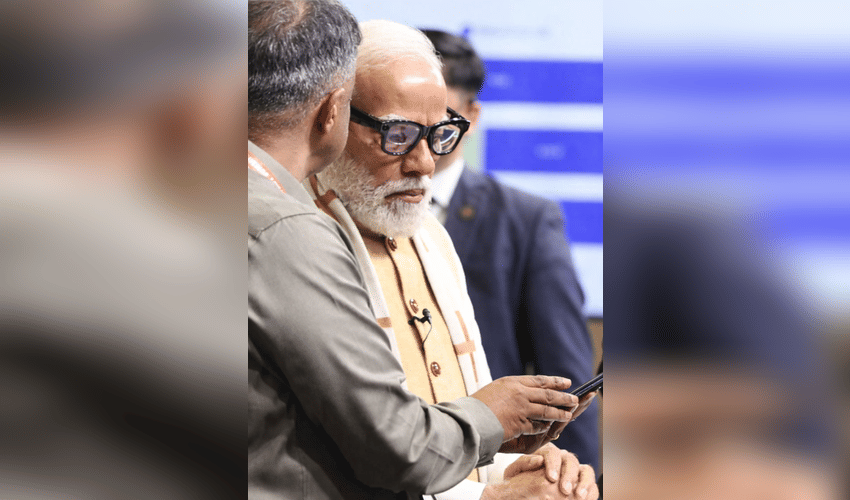

Narendra Modi was seen sporting a sleek, spectacle-like wearable at the ongoing AI Summit— a device that appeared straight out of a science fiction film. The gadget, called Sarvam Kaze, is an indigenously developed AI-powered wearable that does far more than rest on the face. It listens, understands, responds in real time, and captures what the user sees.
Developed by Sarvam AI, Sarvam Kaze is part of a broader effort to build AI solutions tailored to India-specific needs. The company is among 12 teams working on indigenous foundational AI models. The wearable has been fully designed and built in India, and users can create customized experiences through the Sarvam platform.
The Prime Minister wore the device while inaugurating the India AI Impact Expo 2026 during a walkthrough of the exhibition. The moment was shared on X by Pratyush Kumar, Co-Founder of Sarvam AI, who noted that the Prime Minister was the first person to try the device. According to Kumar, Sarvam Kaze shifts intelligence from screens into the real world, enabling immersive AI-powered interactions. The product is expected to hit the market in May.
Beyond the wearable, Sarvam AI has introduced several other AI solutions in recent weeks. These include Sarvam Akshar for high-accuracy digitization of complex documents, Sarvam Studio to help creators produce multilingual content, and Saaras V3, an advanced speech recognition model. The company is also developing large language and speech models tailored for Indian languages to power voice interfaces, document processing, and citizen services.
India’s broader AI roadmap aligns with the Prime Minister’s vision of democratizing technology and addressing India-centric challenges while generating economic and employment opportunities. In March 2024, the Government launched the IndiaAI Mission with an allocation of Rs 10,372 crore to strengthen the national AI ecosystem.
Within two years, the mission has onboarded over 38,000 GPUs to create a shared compute facility for startups and academic institutions at subsidized rates. Twelve teams have been shortlisted to develop indigenous large language models, while 30 applications have been approved for India-focused AI use cases. Talent development efforts include support for thousands of undergraduate, postgraduate, and PhD students. Additionally, 27 India Data and AI Labs have been established, with hundreds more identified. India is currently hosting the India AI Impact Summit from February 16–20 at Bharat Mandapam, bringing together global policymakers, industry leaders, researchers, startups, and students to shape the future of AI.



