



News
Maharashtra: Second Mountain Tunnel of Bullet Train Project in Palghar Nears Breakthrough
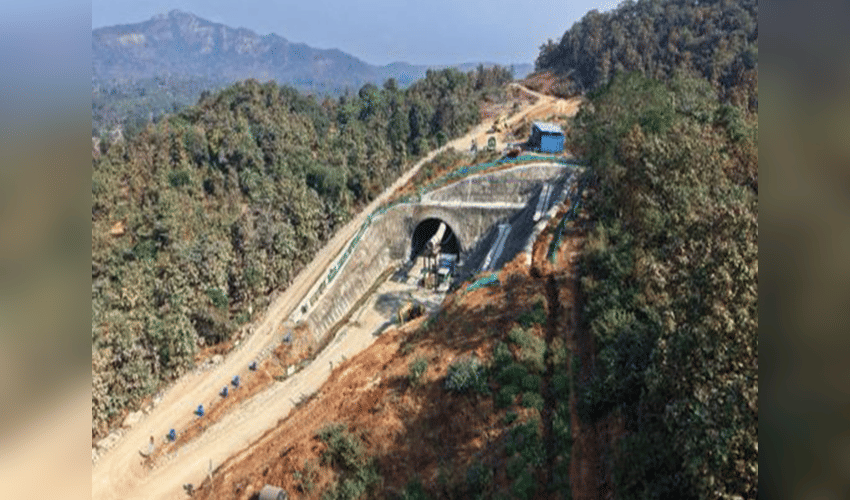

A significant milestone is set to be reached on Tuesday in the second mountain tunnel of the Mumbai-Ahmedabad Bullet Train project in Palghar district, Maharashtra. The tunnel, measuring 454 meters in length and 14.4 meters in width, will accommodate both the ‘up’ and ‘down’ tracks. This marks the second tunnel breakthrough in Palghar within a month, following the first at MT-5 near Safale on January 2, 2026.
The MT-6 tunnel excavation was completed from both ends using the New Austrian Tunnelling Method (NATM), a controlled drill-and-blast technique suited for complex geological conditions. The process, which took 12 months, allows structural reinforcements such as shotcreting, rock bolts, and lattice girders to be applied in real-time. Safety has been ensured through geotechnical monitoring, fire safety measures, proper ventilation, and controlled entry systems.
Construction across Maharashtra is progressing rapidly. The project’s longest river bridge over the Vaitarna River has reached the pier level, while foundation work continues on the Ulhas and Jagnisarkhya rivers. All four stations are under construction, and work is advancing on the 21 km tunnel between Bandra Kurla Complex (BKC) and Shilphata, which includes long-span steel bridges over highways. Currently, seven mountain tunnels are under construction in Palghar.
Progress of the mountain tunnels is as follows: MT-1 (0.820 km) – 16% complete; MT-2 (0.228 km) – preparatory work ongoing; MT-3 (1.403 km) – 41% complete; MT-4 (1.260 km) – 32% complete; MT-5 (1.480 km) – 57% complete, breakthrough achieved on January 2, 2026; MT-6 (0.454 km) – 47% complete, breakthrough expected today; MT-7 (0.417 km) – 29% complete.
The Mumbai-Ahmedabad High-Speed Rail (MAHSR) project spans approximately 508 km, with 352 km in Gujarat and Dadra & Nagar Haveli, and 156 km in Maharashtra. As of January 27, 2026, about 334 km of viaducts, 17 river bridges, and 12 major crossings over national highways, railways, and other infrastructure have been completed. Track laying and electrification in the Gujarat section are progressing rapidly.



