



Economy
India and New Zealand announced a free trade agreement to boost trade and investment.
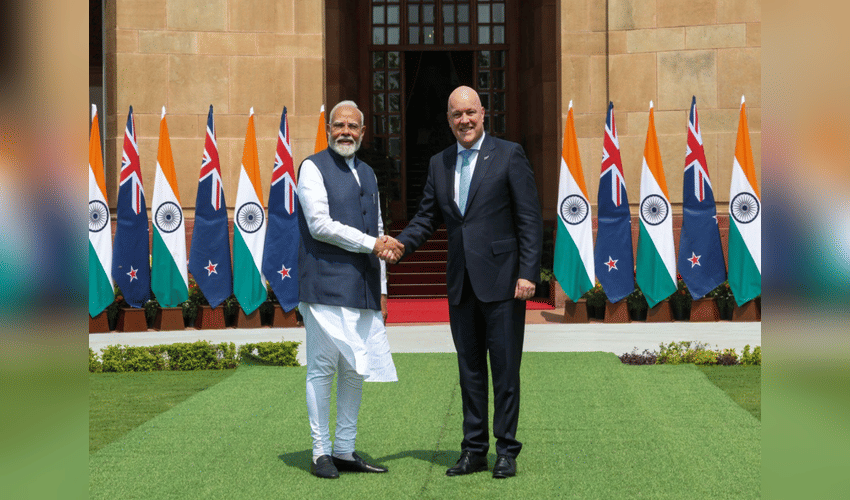

Prime Minister Narendra Modi and New Zealand Prime Minister Christopher Luxon held a telephone conversation on Monday to jointly announce the conclusion of a landmark India–New Zealand Free Trade Agreement (FTA). Finalised in a record nine months after negotiations began during PM Luxon’s visit to India in March 2025, the agreement reflects strong political will and shared ambition to deepen bilateral ties.
The leaders said the FTA will act as a catalyst for greater trade, investment, innovation, and people-to-people cooperation. It is expected to significantly enhance market access, promote investment flows, and strengthen strategic cooperation across sectors including defence, education, sports, and services.
With the FTA as a foundation, both sides expressed confidence in doubling bilateral trade within five years. New Zealand has committed to investing USD 20 billion in India over a 15-year period, backed by a rebalancing mechanism that allows suspension of trade concessions if investment targets are not met.
A key highlight of the agreement is services and mobility. New Zealand has offered market access in 118 services sectors and MFN treatment in 139 sectors, along with a first-ever annex on health and traditional medicine services. The FTA also includes strong provisions for MSMEs, a robust Rules of Origin framework, and enhanced trade facilitation.
On mobility, New Zealand has signed its first Annex on Student Mobility and Post-Study Work Visas, granting Indian students 20 hours per week work rights and post-study visas of up to four years for doctorate holders. A new temporary employment pathway will allow up to 5,000 Indian professionals to work in New Zealand at any time, alongside a working holiday visa for 1,000 Indian youth annually.
India has offered market access to New Zealand in 106 services sectors and MFN treatment in 45 sectors. In goods trade, India’s average MFN tariff will progressively reduce from 16.2 per cent to 9.06 per cent over ten years, with sensitive sectors remaining excluded. Bilateral trade continues to grow, with total trade in goods and services reaching USD 2.4 billion in 2024. The FTA is expected to boost trade flows, improve regulatory certainty, and strengthen long-term economic and strategic ties between India and New Zealand.



