



Military
Dassault Rafale-F5: The powerful new 'Super Rafale' has made its debut.
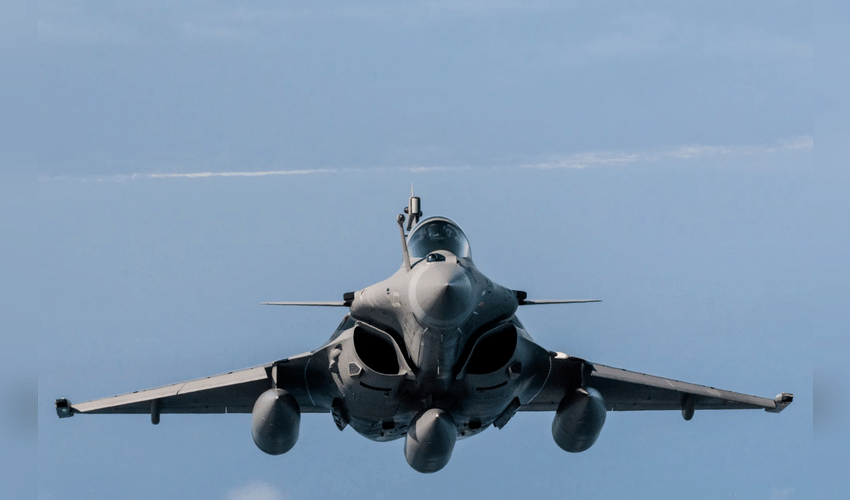

The Dassault Rafale F5-often promoted as the “Super Rafale” marks a major leap forward for the iconic fourth-generation fighter. It brings upgraded sensors, stronger networking features, advanced electronic warfare tools, and a more capable weapons suite. These improvements make it arguably the most advanced version of the Rafale ever built, significantly boosting its lethality, survivability, and multi-role performance.
Still, despite these enhancements, the Rafale F5 remains anchored to an older design philosophy created before modern stealth became central to air combat. Its airframe, shaped during a time when aerodynamic efficiency outweighed signature reduction, prevents it from achieving the level of low observability demanded on today’s battlefields. Unlike fifth- and sixth-generation fighters, which thrive on stealth and deep sensor fusion, the Rafale F5 cannot fully disappear from enemy radars. It can jam, deceive, and evade, but it cannot leverage the kind of “invisibility” and integrated warfare tactics that define modern air superiority.
In beyond-visual-range combat, victory depends on the ability to detect first, act first, and remain hidden. Fifth-generation platforms like the F-35 and F-22 function not only as fighters but as command-and-control hubs, fusing information from satellites, sensors, electronic warfare platforms, and autonomous systems into a unified network. Even with its updated avionics, the Rafale F5 connects to this network rather than shaping or dominating it—placing it at a disadvantage as air warfare increasingly becomes networked, AI-assisted, and autonomous.
The small window during which upgraded fourth-generation jets could challenge fifth-generation aircraft is rapidly closing. The F-35 has matured into a powerful sensor-fusion platform, while the F-22 continues to surpass all rivals in air-to-air combat and network orchestration. Meanwhile, sixth-generation programs like the US NGAD or China’s J-36 and J-50 aim to push capabilities further with adaptive stealth, AI decision-making, and loyal wingman drones designed to overwhelm enemy defenses and disrupt their targeting systems.
Against this backdrop, the Rafale F5—remarkable though it is—resembles a highly refined fourth-generation jet entering a world dominated by fifth- and sixth-generation systems. It continues to appeal to nations seeking strong capabilities without the high cost or political strings attached to next-generation programs. But relying on such incremental improvements risks sacrificing long-term survival for short-term affordability. Opponents equipped with stealth, electronic attack, distributed fires, and autonomous weapons will exploit the inherent limitations of legacy airframes.
The Rafale F5 retains substantial value. It excels in permissive or moderately contested environments—Mediterranean patrols, counterterrorism missions, or regional deterrence duties—where advanced air defenses are absent or minimal. In major conflicts, it can serve as a standoff strike aircraft, weapons truck, or electronic attack support for more advanced fighters. But confusing these specialized uses with genuine parity against next-generation fleets is a strategic mistake.
Ultimately, the Rafale F5 forces decision-makers to choose: continue investing in a refined but fundamentally aging platform, or commit early to sixth-generation systems built for the future battlespace. Relying on upgrades to bridge the gap between generations may feel safer in the short term but risks fielding forces unprepared for high-end, contested environments.
Future air dominance will depend not on raw speed or maneuverability but on stealth, networks, and human-machine teaming moving at the pace of digital warfare. The Rafale F5, as impressive as it is—much like a beautifully restored classic car—cannot fully align with this new paradigm. It remains useful today, but air forces seeking true long-term superiority must invest in platforms engineered for the AI-driven, multi-domain conflicts of tomorrow.
Possessing Rafale F5s extends capability and service life, but it must not be mistaken for lasting dominance against adversaries deploying stealth aircraft, autonomous systems, and integrated sensor networks. The harsh truth is that fighting tomorrow’s battles with even the best version of yesterday’s fighter risks losing pilots, assets, and strategic advantage. Survival in future warfare demands transformation, not incremental improvements—building fleets for what is coming, not for what once was.



