



Military
US F-15 Airman's 3-Word Radio Message After Ejecting Over Iran Revealed
Published On Mon, 06 Apr 2026
Fatima Hasan
6 Views
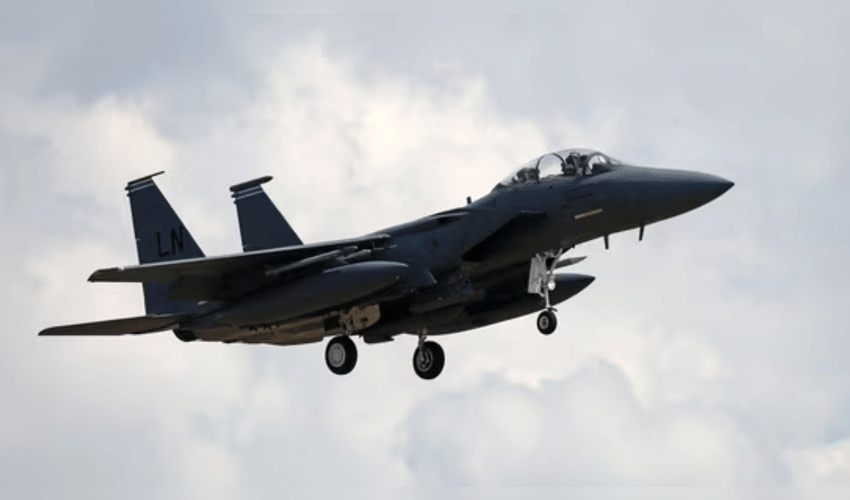

A US F‑15 airman’s brief three‑word radio call after ejecting over Iran has emerged as a pivotal moment in one of the most tightly watched rescue operations of 2026. The weapons systems officer, flying in an F‑15E Strike Eagle that was shot down deep inside Iranian airspace, transmitted a short but powerful phrase that sparked both relief and suspicion inside Washington’s command chain.
According to US officials and media reports, the airman’s message after punching out was “God is good.” President Donald Trump later told Axios he initially heard the phrase as “Power to be God,” which he said sounded like something a Muslim might say, but White House and defense sources clarified that the actual words were the English line tied to the officer’s Christian faith. Those close to the pilot described the phrase as consistent with his character and spiritual outlook, even in extreme stress. Instead of a long, technical sign‑off, he chose a simple, almost devotional statement that carried far more emotional weight than typical military jargon.
To the public, “God is good” may sound like a private prayer. To US war‑room planners, it was an open channel message that had to be treated as a potential tactical signal. Officials familiar with the operation say they worried the transmission might have been made under Iranian coercion, with Tehran using the downed pilot’s radio to lure a rescue team into an ambush. Because the phrase was not a standard distress code, it forced a tense internal debate: was the pilot still free and in control of his radio, or was he already in Iranian hands and being used as a bait? That uncertainty shaped how quickly and how boldly the US was willing to move aircraft and special‑operations forces into Iranian territory.
By the time the US mounted its rescue, the airman had already survived a harrowing sequence. He had ejected over southwest Iran, landed in steep, rugged terrain, then hiked several miles while trying to remain hidden. Photographs shared by US officials later showed him taking shelter in a narrow rock crevice, relying on a handgun and basic survival gear as he waited for extraction.
The joint US–Israeli special‑forces team that reached him about 48 hours after the shoot‑down has described the operation as high‑risk, conducted in mountainous terrain and under constant threat of Iranian air and ground surveillance. The success of the mission cemented the airman’s status as a rare case of a downed pilot recovered alive from hostile Iranian soil—a feat that some senior officials have publicly referred to as an “Easter miracle.”
The episode has also drawn attention to the role of personal belief in modern combat. In an era of drones, encrypted networks, and satellite targeting, the fact that a pilot’s last words before capture were a three‑word prayer underscores how deeply human war still is. The story has become a case study in how a single line of radio traffic can sway decision‑makers, influence public perception, and blur the line between genuine faith and psychological warfare. As the US and Iran continue to face off in a tense regional standoff, the “God is good” transmission will likely be cited for years as a reminder that even in the most high‑tech battles, the smallest human moments can fundamentally change the course of events.
Disclaimer: This image is taken from Hindustan Times.



