



Military
Rajnath Singh's Bold Claim: Nehru Pushed Public Funds for Babri Masjid, Patel Said No
Published On Wed, 03 Dec 2025
Fatima Hasan
14 Views
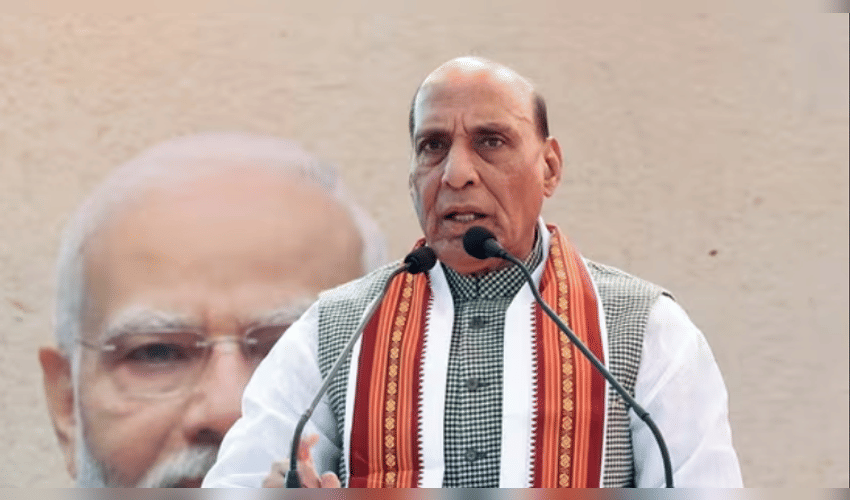

Defence Minister Rajnath Singh recently sparked a fresh political debate during an event in Gujarat by alleging that India’s first Prime Minister, Jawaharlal Nehru, once proposed reconstructing the Babri Masjid using taxpayer money. Singh claimed that the idea was firmly opposed by Sardar Vallabhbhai Patel, who insisted that public funds should never be used for religious structures. Speaking at a Unity March held in Sadhli village near Vadodara on the occasion of Patel’s 150th birth anniversary, Singh described Patel as a leader with a clear and principled understanding of secularism, someone who drew a strict line between government responsibility and religious projects.
Singh contrasted the alleged Babri Masjid proposal with the restoration of the Somnath Temple, explaining that the temple’s reconstruction cost around thirty lakh rupees and was covered entirely through public donations raised via a trust. No money from the government’s treasury was used, he said, and this approach, in his view, reflected what true secularism should look like. The Defence Minister added that the Ram Temple in Ayodhya followed the same model, being built exclusively through private contributions rather than state funding.
The minister also revisited another anecdote, claiming that Nehru once suggested that donations collected for Patel’s memorial should instead be used for building wells and roads in villages. Singh criticized this idea, arguing that infrastructure development is the government’s responsibility and that diverting funds meant to honor a national leader was misguided. He praised Prime Minister Narendra Modi for giving Patel the national recognition he deserved, citing the Statue of Unity as an example of how Patel’s contributions to India are now properly acknowledged. Singh further remarked that India’s position on Kashmir could have been stronger if Patel’s advice had been fully followed during the years after Independence.
These statements, though political in nature, revive long-standing debates about the roles of India’s early leaders and the contrasting visions they held for the nation. Such claims often invite scrutiny from historians, as they reflect how interpretations of the past are used to frame present-day narratives. Yet they also highlight how issues involving public funds, religious sites, and national icons continue to influence political discourse in India.
Despite these controversies, Sardar Vallabhbhai Patel’s legacy remains central to the story of modern India. His decisive role in integrating more than five hundred princely states into one united country stands as one of the greatest achievements in Indian history. Rajnath Singh’s remarks, whether viewed as commentary or political positioning, once again place Patel’s leadership and Nehru’s decisions under the spotlight, showing how the past continues to shape contemporary discussions about national identity and governance.
Disclaimer: This image is taken from Hindustan Times.



