



Economy
India and France Aim to Double Bilateral Trade to 32 Billion dollar Within Five Years
Published On Mon, 15 Jun 2026
Fatima Hasan
5 Views
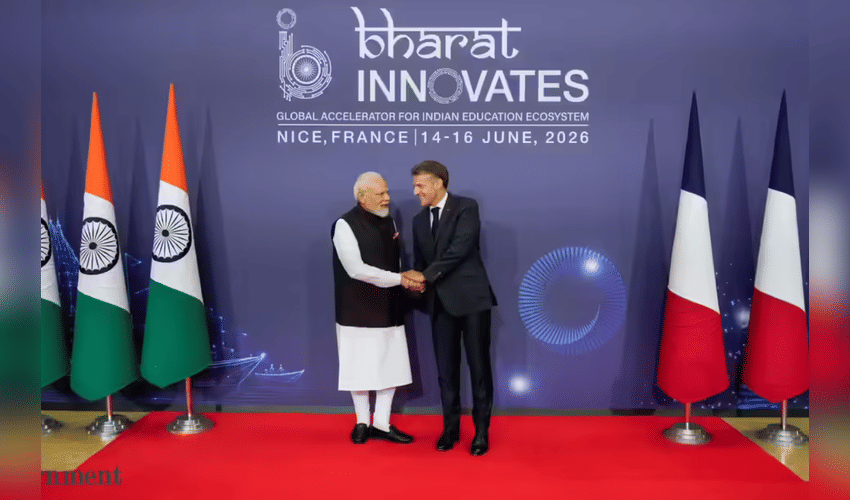

Prime Minister Narendra Modi and French President Emmanuel Macron held wide-ranging discussions in Nice, charting an ambitious new direction for India–France ties. One of the key highlights of the meeting was the shared goal of doubling bilateral trade to nearly $32 billion over the next five years, reflecting the growing strategic and economic importance of the partnership. The meeting resulted in 13 major agreements and initiatives covering trade, defence, technology, nuclear energy, education, and digital cooperation, signalling a deeper and more comprehensive collaboration between the two nations.
A major outcome of the talks was the launch of the India–France Innovation Roadmap 2030, along with a joint framework on artificial intelligence. The initiative aims to strengthen cooperation in emerging technologies by encouraging partnerships between startups, research institutions, universities, and industries from both countries. To ensure progress toward the new trade target, both governments also agreed to create a high-level monitoring mechanism and begin a dedicated dialogue on economic security.
Defence cooperation remained a central pillar of the discussions. India’s proposed acquisition of 114 Rafale fighter aircraft from Dassault Aviation was reviewed in detail. Foreign Secretary Vikram Misri reiterated that India is focusing heavily on local manufacturing and technology transfer under the Make in India initiative. The broader emphasis is on co-development, co-design, and co-production, allowing India to expand its domestic defence capabilities while deepening collaboration with France.
Civil nuclear energy also featured prominently in the bilateral talks. Both leaders reviewed progress on the long-pending Jaitapur nuclear power project involving EDF and the Nuclear Power Corporation of India Limited. Discussions covered technical planning, financing, and future implementation strategies. Prime Minister Modi also highlighted India’s recently introduced Shanti legislation, which is expected to create fresh opportunities for foreign companies, including French firms, to directly participate in India’s nuclear sector. The new policy framework may open doors for collaboration in advanced modular reactors and small modular reactor technologies, while also encouraging partnerships with India’s private sector.
Technology and innovation emerged as another major focus area during the summit. Modi stressed the importance of adopting a human-centric approach to technological progress, especially in fast-evolving sectors such as artificial intelligence and digital infrastructure. The timing is significant, as negotiations around the India–European Union free trade agreement have recently progressed, potentially creating stronger economic linkages between India and Europe.
Digital cooperation saw a practical expansion through the extension of India’s Unified Payments Interface (UPI) services in France. The payment platform is expected to become operational soon at Paris’ Charles de Gaulle Airport and Nice Airport, making transactions easier for Indian tourists, students, business travellers, and members of the Indian diaspora living in Europe.
Education and talent exchange were also high on the agenda. Modi invited French universities to establish campuses in India under the country’s new education policy reforms. In return, France committed to expanding recognition of Indian educational qualifications and increasing opportunities for academic exchange and talent mobility.
In another significant development, both countries announced plans to establish a National Centre of Excellence for Skilling in Aeronautics and Allied Sectors in Kanpur. The centre will focus on aviation training, research partnerships, and workforce development for aerospace manufacturing and maintenance sectors. Additionally, 19 separate agreements were signed between innovation and research institutions from India and France to strengthen collaboration in science and technology.
The agreements signed during the visit also included cooperation in high-speed rail development, protection of classified information, and enhanced digital innovation initiatives. Together, these measures demonstrate the broad scope of the India–France strategic partnership. The Nice summit has reinforced the long-standing Special Global Strategic Partnership between the two countries. With stronger commitments in trade, defence manufacturing, nuclear cooperation, education, and advanced technology, India and France appear ready to take their relationship into a new era of deeper economic and strategic engagement.
Disclaimer: This image is taken from Indian Defence News.



