



World
How Russia Is Preparing Children for the Wars of Tomorrow
Published On Sat, 29 Aug 2026
Fatima Hasan
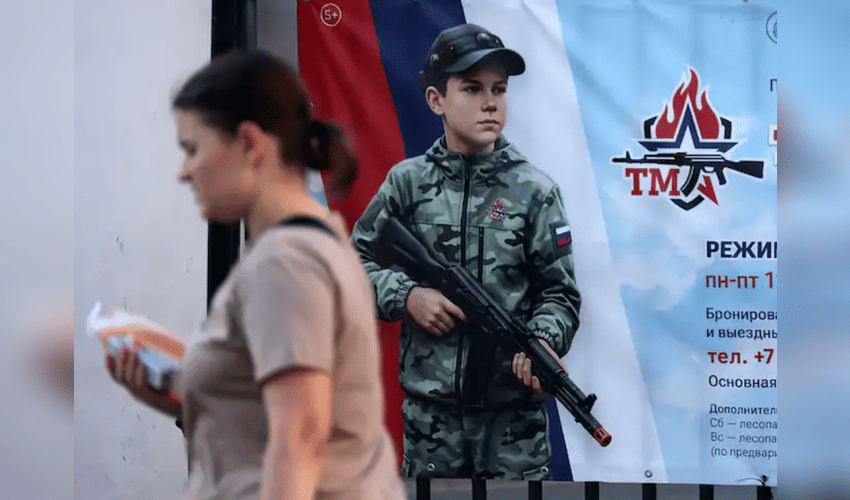

Russian schools are placing a growing emphasis on military training as students prepare to begin the new academic year, with teenagers set to receive more extensive lessons on weapons, battlefield first aid, survival skills and military discipline. The changes are being introduced through the expanded “Fundamentals of Security and Defense of the Motherland” course, under which around half of the weekly teaching time will be dedicated to basic military preparation. Although some military-related subjects were already taught to older students, the revised programme extends the training to children from about 13 years old.
Students will learn about different categories of weapons, including machine guns and anti-tank systems, as well as emergency medical treatment and basic military procedures. The curriculum also introduces lessons on Russia’s national security policy and armed forces, along with subjects covering explosive hazards, chemical and radiation exposure, survival techniques and dealing with stress in conflict situations.
The changes come as Russia continues its war in Ukraine and represent another step in the governments broader effort to integrate patriotic and military themes into education. Critics say the approach risks making warfare and military sacrifice appear routine to young people. Pavel Talankin, a Russian teacher living in exile and co-director of the documentary Mr. Nobody Against Putin, has criticised what he sees as the growing promotion of war within the education system. He argues that repeated messages about enemies and sacrifice can influence childrens attitudes towards violence and the value of human life.
Military influence is also reaching schools through visits by veterans of the Ukraine war. Russian officials have promoted the idea of using veterans as educators, with State Duma Speaker Vyacheslav Volodin calling for former combatants to be present in schools and share their experiences with students. The policy echoes aspects of the Soviet education system, when schoolchildren received compulsory military preparation that included activities such as marching, rifle assembly and gas-mask drills. However, researchers say the political message surrounding the training has changed.
Irina Lukyanova, a teacher and researcher of Russias education system, has noted that Soviet-era military preparation was often presented as a way of preventing another devastating war, while the current system places greater emphasis on militarism and readiness for conflict. Military-related activities have already become widespread across Russian schools. A survey of more than 2,600 school leaders and teachers by the state-backed Knowledge Society found that most schools hold events connected to the war in Ukraine, while many invite military participants to speak to students or conduct lessons about the conflict.
The governments efforts also extend beyond ordinary classroom education. Russia has expanded youth military programmes such as “Zarnitsa,” a modern version of a Soviet-era military game. Children are divided into teams and introduced to roles such as commanders, medics, drone operators and sappers. Their activities include simulated combat exercises, virtual-reality training, trench drills and mock weapon exercises. Participation in Zarnitsa has increased significantly, with hundreds of thousands of children taking part. The programme is supported by the state-backed Movement of the First and receives substantial government funding.
Older students can also attend Avangard military training centres, where they undergo short residential programmes designed around military-style routines. Russia has established dozens of such facilities, while some regions have introduced specialised camps for teenagers featuring military-themed training. Government spending on patriotic education has risen alongside these initiatives. Billions of rubles are being allocated to programmes aimed at promoting patriotism among young people, while enrolment in military cadet schools and specialised recruitment programmes has also grown substantially in recent years.
Another major component is the weekly “Conversations About Important Things” class, introduced in 2022. The lessons cover patriotism, Russian history and subjects linked to the Kremlins interpretation of the war in Ukraine. An adapted version for preschool children is also being introduced. The education system has undergone an even more extensive transformation in areas of Ukraine under Russian control. Schools in Russian-occupied parts of Donetsk, Luhansk, Zaporizhzhia and Kherson are using Russian-approved curricula and history materials. Critics have accused Moscow of using education to reshape childrens understanding of their history and national identity.
Taken together, the changes show how military themes are becoming increasingly embedded in Russian childhood, from regular school lessons to youth competitions, military camps and patriotic programmes. Researchers and critics say the long-term objective appears to be creating a generation that is more accustomed to military service and more accepting of the Kremlins narrative surrounding the war. As Russias conflict with Ukraine continues, the countrys education system is therefore becoming not only a place for academic learning, but also an important channel through which the state promotes military readiness, patriotism and its wider political worldview.
Disclaimer: This image is taken from Bloomberg.



