



News
Delhi Records AQI of 270 as PM2.5 Remains the Leading Pollutant Amid Poor Air Quality
Published On Fri, 20 Nov 2026
AHN News Desk
3 Views
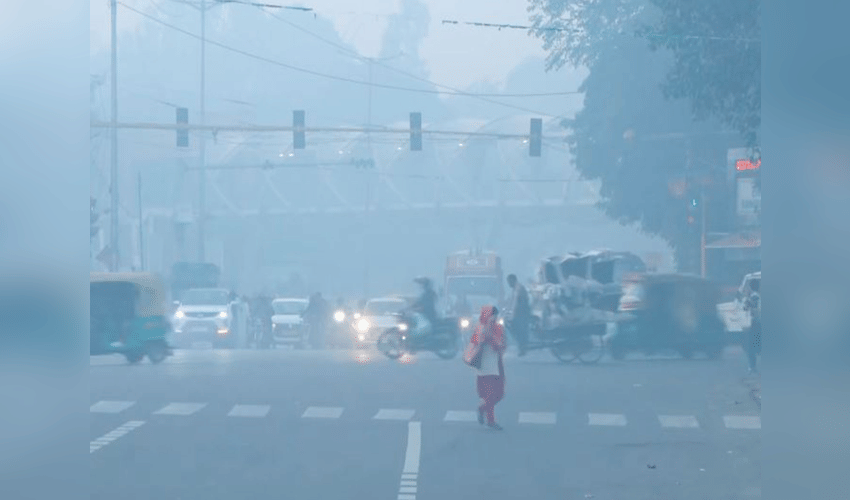

Delhi continued to struggle with poor air quality on Friday morning, as the citys overall Air Quality Index (AQI) stood at 270, according to the Central Pollution Control Board (CPCB). PM2.5 remained the dominant pollutant, contributing significantly to unhealthy air conditions across several parts of the national capital. CPCB data recorded at 7:05 am showed that multiple air quality monitoring stations reported AQI readings above 300, indicating very poor pollution levels. Siri Fort recorded the highest AQI at 348, followed by JNU at 338 and Pusa at 337. Chandni Chowk and Burari Crossing both registered an AQI of 331.
Other locations also reported elevated pollution levels. ITO recorded an AQI of 322, while Jahangirpuri stood at 311. Punjabi Bagh and North Campus registered readings of 309 and 308, respectively. Meanwhile, RK Puram recorded an AQI of 259 and Anand Vihar reported 267, keeping both areas within the poor category. According to CPCB standards, an AQI between 0 and 50 is classified as good, 51-100 as satisfactory and 101-200 as moderate. Readings between 201 and 300 fall under the poor category, while 301-400 are considered very poor. An AQI between 401 and 500 is classified as severe.
Meanwhile, dense fog was reported in several parts of Thiruvarur district in Tamil Nadu on Friday morning. The latest pollution readings come shortly after the Commission for Air Quality Management (CAQM) revoked Stage III restrictions under the Graded Response Action Plan (GRAP) across Delhi-NCR on November 17. The decision was taken following an improvement in air quality. In its official statement, the commission confirmed that restrictions under Stage III would be withdrawn with immediate effect.
Following the withdrawal, government schools, government-aided institutions and recognised private schools across Delhi were directed to resume physical classes for all students. Delhi Chief Minister Rekha Gupta reviewed the capitals pollution-control initiatives during a high-level meeting at the Integrated Command and Control Centre (ICCC) of the Delhi Pollution Control Committee (DPCC). During the meeting, she stated that Delhi had experienced some relief in November compared with air quality conditions over the previous decade. However, she stressed that authorities must continue taking strict measures to tackle pollution.
The Chief Minister instructed government departments and civic agencies to strengthen coordination and ensure that pollution-control efforts deliver measurable results. She specifically directed the Municipal Corporation of Delhi (MCD) and the Public Works Department (PWD) to intensify road-cleaning activities through mechanised sweeping, water sprinkling and road washing. Officials were also asked to ensure regular cleaning of footpaths and central road dividers.
The government has additionally increased inspections at construction and demolition sites to prevent dust pollution. Gupta instructed officials to ensure that construction sites have proper green nets, barricades and windbreakers in place. She emphasised that dust-control measures must be implemented effectively rather than treated as a formality. With PM2.5 pollution continuing to affect several neighbourhoods and numerous monitoring stations reporting very poor air quality, Delhi faces the challenge of sustaining recent improvements. Strong enforcement, coordinated government action and consistent monitoring will remain essential to controlling pollution as winter conditions continue across the capital.
Disclaimer: This image is taken from ANI.



