



World
War risks drag global growth to 3.1 pc: IMF
Published On Thu, 16 Apr 2026
Asian Horizan Network
4 Views
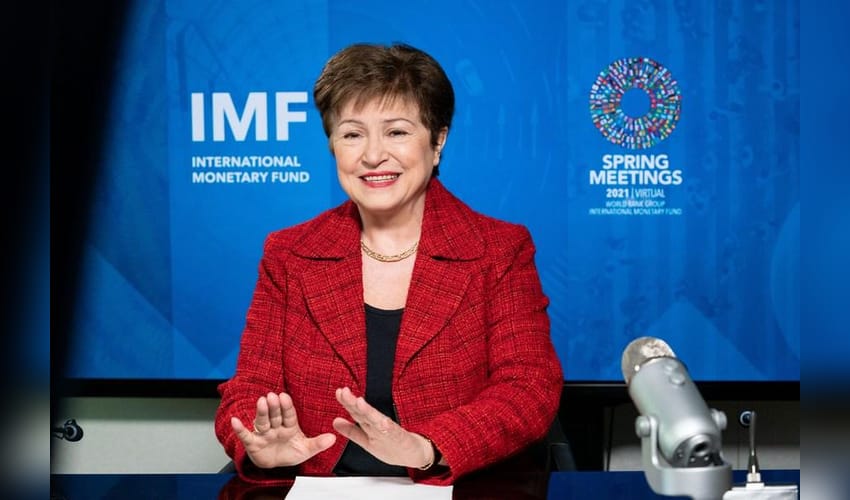

Washington, April 16 (AHN) The global economy is set to slow in 2026 as war-driven disruptions in energy supplies and trade routes push up prices and dent growth, International Monetary Fund (IMF) Managing Director Kristalina Georgieva said, warning of tougher conditions if the conflict persists.
“Even if the conflict is short-lived, extensive infrastructure damage and supply-chain disruptions are pushing prices up and slowing global growth down from 3.4 per cent last year to 3.1 per cent in 2026,” Georgieva said at the IMF’s Spring Meetings press briefing on Wednesday (local time).
She cautioned that a prolonged conflict and sustained high oil prices could sharply worsen the outlook. “In the most adverse case, growth could fall to 2 per cent, and the shock is global,” she said, adding that “all countries are affected by higher energy prices,” though the burden is “highly asymmetric” and heavier on energy-importing and low-income economies.
The IMF flagged mounting risks from disruptions in supply chains, particularly across Asia. Georgieva said shortages were already emerging “not only of oil and gas, but also of NAFTA, of helium,” warning that the effects would deepen in the coming weeks.
“This is not going to evaporate overnight even if the war ends tomorrow,” she said, noting logistical delays. “A tanker is a slow-moving vessel… it will take 40 days” to reach distant markets, extending the shock.
Inflation risks are also rising. The IMF has “upgraded our projections for inflation for 2026,” reversing earlier expectations of easing price pressures. Georgieva said short-term inflation expectations have increased in the United States and Europe, though “long-term inflation expectations remain well-anchored.”
She warned that supply disruptions could spill into food prices if fertiliser supply chains remain strained. “We might see pressure on food prices,” she said, citing urea prices in Africa doubling from $400 to $800.
On policy, the IMF urged caution. “Look before you leap,” Georgieva said, advising central banks with strong credibility to “wait and see” rather than react aggressively, while weaker systems may need earlier action.
Fiscal policy remains constrained. “Global public debt is on track to breach 100 per cent of GDP in 2029,” she said, warning that governments must balance support for vulnerable populations with maintaining fiscal credibility.
She cautioned against broad interventions. “Such untargeted actions will only prolong the pain of high prices,” she said, referring to blanket subsidies and tax cuts.
The IMF expects demand for its financial assistance to rise. Georgieva said near-term support needs could range between $20 billion and $50 billion, with “prospective demand for new programs from at least a dozen countries,” many in sub-Saharan Africa.
She stressed that vulnerable regions face the sharpest impact. “The majority of sub-Saharan African countries are in this quadrant of vulnerability,” she said, adding the Fund would “move very swiftly to respond to requests.”
Despite the near-term shock, Georgieva said countries must not lose focus on structural reforms. “A strong economy is the best buffer,” she said, urging policymakers to lift productivity and rebuild fiscal space.
The IMF chief also pointed to resilience in emerging markets. “Look at India today. India’s growth is more than two times higher than the average global growth,” she said, attributing it to strong fundamentals.



