



Lifestyle
Trump's 'Central Casting' remark that sparked headlines has a Hollywood connection
Published On Sat, 06 Jun 2026
Lalit K Jha
2 Views
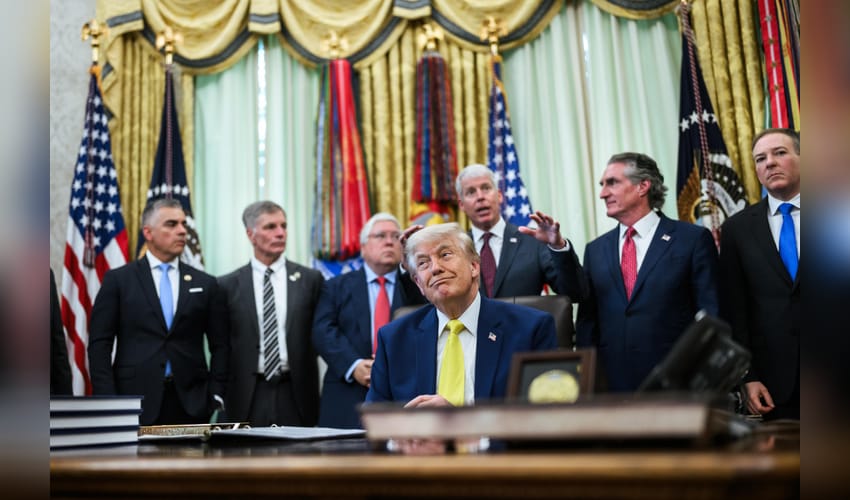

Washington, June 6 (AHN) After nearly two decades of covering the White House, I have learned that no two Oval Office events are ever the same. Every US President has a different style. Every appearance has its own rhythm. And every question carries the possibility of producing an unexpected moment.
This week, one such moment unfolded in a way I could not have anticipated.
Having had the privilege of covering President Donald Trump during both of his terms in office, I have had the opportunity to ask him questions on numerous occasions.
As a member of the White House press corps, I have witnessed his willingness to engage with reporters on a wide range of subjects. Whether the topic is trade, foreign policy, immigration, national security, energy or international relations, he often takes questions from journalists representing diverse outlets, including members of the foreign press corps.
That experience was very much on my mind as I prepared to enter the Oval Office this week.
Steps away from the Oval Office, standing in the West Wing colonnade overlooking the Rose Garden, I was thinking about the question I would ask if called upon.
My first choice was to ask about India-US cooperation in clean coal technology and energy security. But news often moves quickly inside the White House. Secretary of State Marco Rubio had recently concluded his visit to India, and a US trade delegation had just returned from negotiations there. Thus, trade and the future of India-US economic relations deserved priority.
A few moments later, we walked into the Oval Office. Like every reporter in the room, I raised my hand and waited.
The Oval Office is one of the most recognisable rooms in the world, but for reporters, it can also be one of the most competitive. Journalists from major American television networks, international news organisations, wire services, newspapers and foreign media outlets often find themselves vying for a limited number of questions.
There are no guarantees.
The President decides whom to call on, and often there are far more hands in the air than time available.
When my turn came, I began asking about India-US relations, the recent trade discussions and his engagement with Prime Minister Narendra Modi.
Before getting into the substance of my question, President Trump paused and looked at me.
“Are you from India, by any chance?” he asked.
I replied that I was.
Then came another remark.
“I thought you were from Germany?” he said before quickly adding that he was joking.
The room laughed.
Then he looked at me and said: “You’re Central Casting.”
Almost immediately, he added: “That’s a good thing.”
The room laughed again, and the conversation quickly moved to the substance of my question. But within minutes, the phrase 'Central Casting' was generating attention. Friends, colleagues and readers began reaching out. Many wanted to know what exactly the President meant.
The expression comes from Hollywood’s Central Casting agency, which for generations supplied actors and extras to film and television productions. Over time, 'Central Casting' has became part of American political vocabulary, referring to someone who perfectly fits a particular image or role.
The phrase has long been part of American political and cultural language. Politicians, journalists and commentators often use it to describe someone who appears perfectly suited for a particular role — the military officer who looks exactly like a military officer, the police chief who looks as though he stepped out of a television drama, or the politician who seems tailor-made for public office.
President Trump has employed the expression on numerous occasions over the years. He has used it to describe military leaders, public officials, business executives and foreign leaders whose appearance, bearing or personality fit a particular image. He recently used this for Chinese President Xi Jinping. Like many of his unscripted observations, the comments often attract attention because they are spontaneous and memorable.
Reactions to such remarks have varied depending on the circumstances. Some people view them as colourful observations or compliments, others sometimes analyse them more deeply than they were likely intended. In most cases, however, the phrase is understood in the traditional American sense — as a way of saying that someone looks exactly like the person one would expect to occupy a particular position.
For me, however, what stood out was not the phrase itself.
What stood out was the interaction. President Trump’s style is often spontaneous and unscripted. Questions can come from virtually any direction and on almost any subject. Whether the topic concerns India, Europe, the Middle East, trade negotiations, immigration or domestic politics, he rarely shies away from taking questions. Whether one agrees with his positions or not, he rarely appears unprepared and is generally willing to engage directly on the subject at hand.
As I stepped out of the Oval Office along with other journalist colleagues and walked through the West Wing Collonade, I reflected on how quickly the focus had shifted.
I had entered the room prepared to ask about trade negotiations and bilateral cooperation. Instead, a brief off-the-cuff remark from the President Trump had sparked headlines, social media discussions and countless questions about a phrase rooted in Hollywood history.
That is often the nature of covering President Trump. Formal policy discussions can suddenly take an unexpected turn. A carefully prepared question can begin with humour before moving to substance.