



World
South Korean President hails PM Modi's Viksit Bharat 2047 vision
Published On Mon, 20 Apr 2026
Asian Horizan Network
3 Views
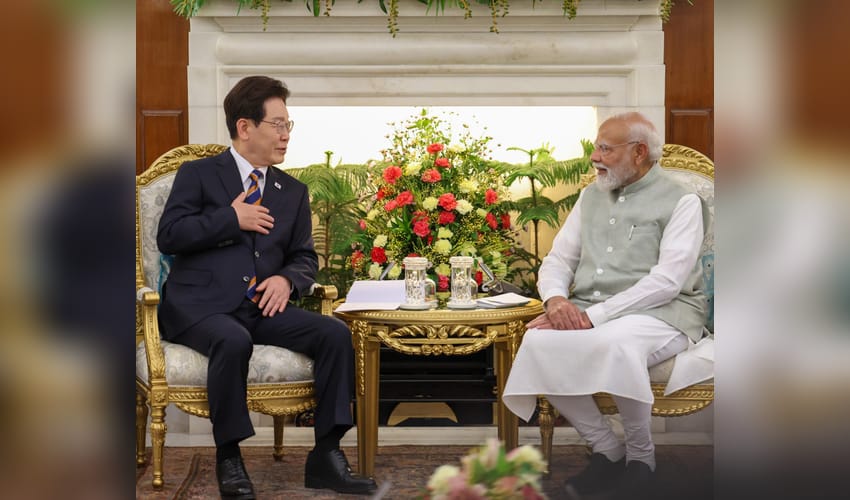

New Delhi, April 20 (AHN) South Korean President Lee Jae Myung said on Monday that he and Prime Minister Narendra Modi agree that India and South Korea can be most ideal partners for comprehensive cooperation to promote mutual growth and innovation.
While addressing a joint press meet with PM Modi following their talks in New Delhi, President Lee announced that India and South Korea have agreed to upgrade economic cooperation framework to create new drivers for mutual growth. He stated that India and South Korea will establish an industrial cooperation committee, the first ministerial platform for economic cooperation between two nations to strengthen cooperation in trade and investment and strategic areas such as critical minerals, nuclear energy, and clean energy.
"In the era of hyper uncertainty, we share our view that Korea and India can be the most ideal partners for comprehensive cooperation to promote mutual growth and innovation. Against this backdrop, while we further advance our existing economic cooperation, we have also agreed to expand cooperation in strategic industries such as ship building, finance, AI, and defense, and promote cultural and people-to-people exchanges," he said.
The South Korean President also expressed gratitude to PM Modi for inviting him to India and the warm hospitality extended to him and his delegation. "India is the world's largest democracy and achieving the most dynamic growth and I'm very pleased to pay you state visit to your country for the first time in eight years as president of the Republic of Korea and at the earliest time since taking office."
He noted that India and South Korea have witnessed remarkable advancement in bilateral relations through the signing of a comprehensive economic partnership agreement in 2010 and upgrading of relations to a special strategic partnership in 2015. "Now, we are ushering in a new decade of the special strategic partnership. Today the Prime Minister and I had in-depth discussions on ways to further promote our relations and exchanged views on the regional and global affairs."
He stated that India has emerged as a leader of Global South and hailed India's remarkable development under the Viksit Bharat 2047 vision.
"With the world's largest population and the fourth largest economy, India has emerged as a leader in the Global South. And under your Viksit Bharat 2047 vision, this country is achieving remarkable development and the Republic of Korea has also evolved as a leader in chip building, semiconductors and cultural industries and we are accelerating innovation and growth to achieve a great leap forward to ensure that every Korean can grow together," South Korean President said.
Lee Jae Myung expressed gratitude to Indian government for their constant support to building peace on the Korean Peninsula and stated that South Korea looks forward to India continuing to play a constructive role for peace on the peninsula and within the regions.
He said, "We agreed to maintain close collaboration in addressing regional peace and international issues. Prime Minister Modi and I exchanged our views on the recent events unfolding in the Middle East and agreed that restoring stability and peace in the Middle East is crucial to global security and the economy. I also spoke to the Prime Minister about the Korean government's efforts to build peace on the Korean Peninsula and extended our gratitude to the Indian government for their consistent support on this matter. Korea looks forward to the constructive role that India will continue to play for peace on the peninsula and within the region."
He emphasised that India and South Korea will sustain cooperation for supply stability of energy resources and key commodities such as NAFTA. President Lee announced that he and PM Modi have agreed to speed up the negotiations to upgrade Comprehensive Economic Partnership Agreement (CEPA) to create a more favourable trade and investment conditions for businesses of two nations and fully reflect new trade norms so that both nations can respond to the changing trade environment concerning supply chains in green growth in a more timely manner.



