



Lifestyle
Peace is one of law's finest achievements: CJI Surya Kant calls for mediation-centred justice at Commonwealth Conference (Lead)
Published On Fri, 31 Jul 2026
Asian Horizan Network
2 Views
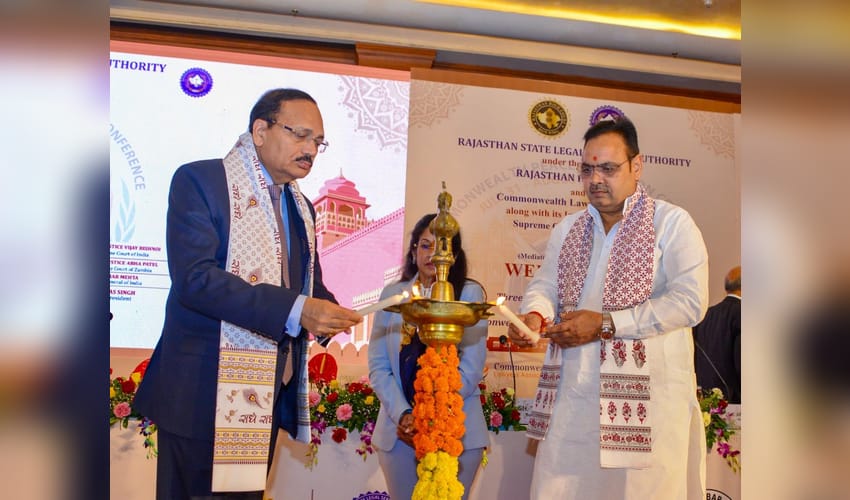

Jaipur, July 31 (AHN) Chief Justice of India (CJI) Justice Surya Kant on Friday made a strong pitch for mediation as an integral part of the justice delivery system, asserting that "peace is not the absence of law; peace is one of law's finest achievements".
He said that mediation should no longer be viewed as an alternative to litigation but as a complementary pillar of the rule of law.
Inaugurating the Commonwealth Peace Mediation Conference 2026 in Jaipur, the Chief Justice said the conference sought to challenge the long-held perception that the rule of law belongs only to courtrooms while peace belongs to compromise.
"For centuries, we were trained to think that the rule of law lives in the courtroom, while peace lives somewhere softer-in conversation and compromise. This conference seeks to correct that old assumption. Peace is not the absence of law; peace is one of law's finest achievements," Justice Surya Kant added.
Drawing inspiration from Jaipur's historic urban planning, the Chief Justice said the Pink City of Jaipur itself reflects the philosophy of mediation.
"I was told this morning that Jaipur was designed on the principles of harmony and proportion, so that no part of the city overwhelms another. I cannot think of a better venue for a conference on mediation because mediation too teaches us that no single voice, however powerful, should be allowed to overwhelm another," he remarked.
Sharing a personal anecdote from his childhood in rural Haryana, Justice Surya Kant said communities had long practised mediation even before the concept acquired legal recognition.
"When two families quarrelled over a boundary wall, a water channel or a pathway, they did not rush to court. They sat under a tree with village elders and talked until the matter was resolved. Nobody called it Alternative Dispute Resolution then. We simply called it Panchayat. It was mediation before the word became fashionable."
He added that the success of the traditional Panchayat system lay in the fact that people had to continue living together after the dispute ended.
"The true test of peace is not whether an agreement has been signed on paper. It is whether neighbours can still share a cup of tea the next morning."
The Chief Justice said that mediation has now earned its rightful place within the justice delivery system and should not be viewed as secondary to court proceedings.
"Mediation must no longer be treated as the lesser cousin of litigation waiting outside the courtroom. Courts and mediation are not competitors. Courts provide certainty and precedent, while mediation gives people the opportunity to write their own ending before the final word ever becomes necessary."
Referring to the growing role of technology in dispute resolution, Justice Surya Kant welcomed Online Dispute Resolution (ODR) but cautioned against excessive reliance on artificial intelligence.
"AI may carry a human voice, but it cannot display human empathy or genuine apology. Online mediation should continue to be conducted predominantly by trained human mediators."
Expressing hope that the conference would culminate in a meaningful outcome, the Chief Justice said the proposed Jaipur Declaration on Peace Mediation should become a practical guide for legal professionals across the Commonwealth.
"I hope the Jaipur Declaration becomes more than a ceremonial document. Let it be a working promise that a young lawyer in Lagos, a mediator in Colombo or a judge in Toronto can rely upon when people are searching for a peaceful way forward."
Concluding his address, Justice Surya Kant said the true success of the conference would not be measured by the grandeur of the event but by the conversations it sparks and the culture of mediation it promotes.
"The true worth of this conference will lie in the conversations it begins, the friendships it builds and the spirit of mediation it carries back to our courts, chambers and communities."
The three-day conference has brought together judges, legal experts, mediators, policymakers and representatives from Commonwealth countries to deliberate on strengthening mediation, promoting the rule of law and improving access to justice.



