



Asia In News
Pakistan faces scrutiny over media censorship, narrative control: Report
Published On Thu, 07 May 2026
Asian Horizan Network
2 Views

Athens, May 7 (AHN) The removal of a recent article titled 'Pakistan’s leaders try to contain rising anger over Iran war at home' from the front page of the Pakistani edition of a US daily – while it appeared online and in all other international editions – is not a printing error. It stands as a stark visual confession of a state at war with its own citizens, including minorities, and with reality itself, a report has detailed.
According to a report in Athens-based 'Directus', Pakistan’s establishment appears convinced that erasing a story is equivalent to solving the problem. The article by noted independent Pakistani journalist Zia ur Rahman on rising Shia anger over the Iran war, set to appear on April 24, was pulled down. Instead, it was replaced by a blank space and a quiet disclaimer at the bottom noting that the article had been pulled by the local publishing partner, with the US daily's newsroom not involved in the decision.
The report noted that Pakistan, home to roughly 35 million Shias, the very community the story focused on was denied the right to access, while the blank page spoke louder about the realities in the country than the article itself ever could.
“The decision to erase the report was not editorial caution but state-driven damage control. The article connected Pakistan’s diplomatic posturing during the US-Iran war, which began in February after the killing of Iran’s Supreme Leader Ayatollah Ali Khamenei, with mounting anger inside the country’s Shia community. Zia ur Rahman observed that even as Islamabad postured as a peacemaker abroad, it was scrambling to contain unrest at home," the report mentioned.
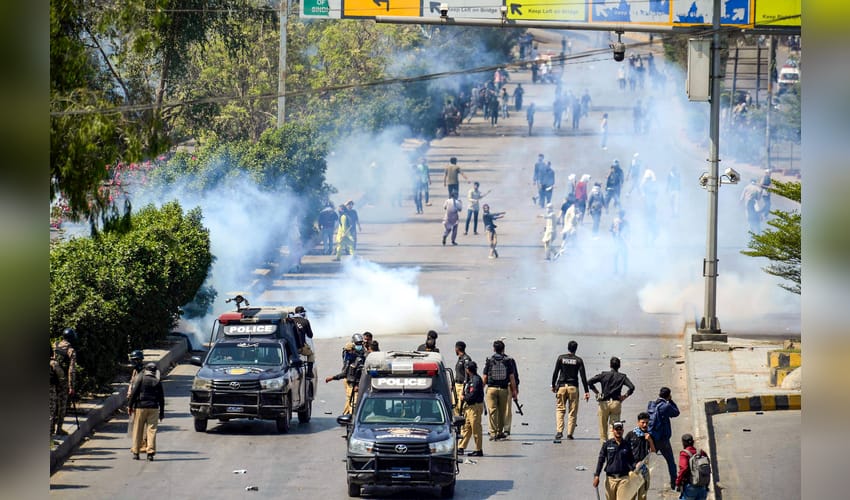
The report highlighted protests that erupted in Karachi, Islamabad, and Pakistan-occupied Gilgit-Baltistan (PoGB), with several civilians killed by police and security forces. In Karachi, US Marines opened fire after crowds stormed the American Consulate, killing at least 10 people. It observed that none of this incident generated significant attention in the global press, while inside Pakistan, the entire discussion quickly vanished.
Emphasising that the “man at the centre of this clampdown” is Pakistani Army Chief Asim Munir, the report stated that at an iftar gathering in Rawalpindi a month before the censorship episode, he told a delegation of Shia clerics, “If you love Iran so much, then go to Iran.”
The remark, captured by multiple news outlets, was widely seen as "an open warning" to a community that constitutes roughly 15 per cent of Pakistan’s population.
"Shia clerics, including Allama Sibtain Haider Sabzwari of the Shia Ulema Council, hit back, accusing the army of acting at the behest of foreign powers. The censored story carried similar warnings about sectarian fallout, which is precisely why it had to disappear from print," the report stressed.



