



World
Pakistan aims to turn Mecca defence pact into united front against Israel and India: Report
Published On Mon, 10 Aug 2026
Asian Horizan Network
3 Views
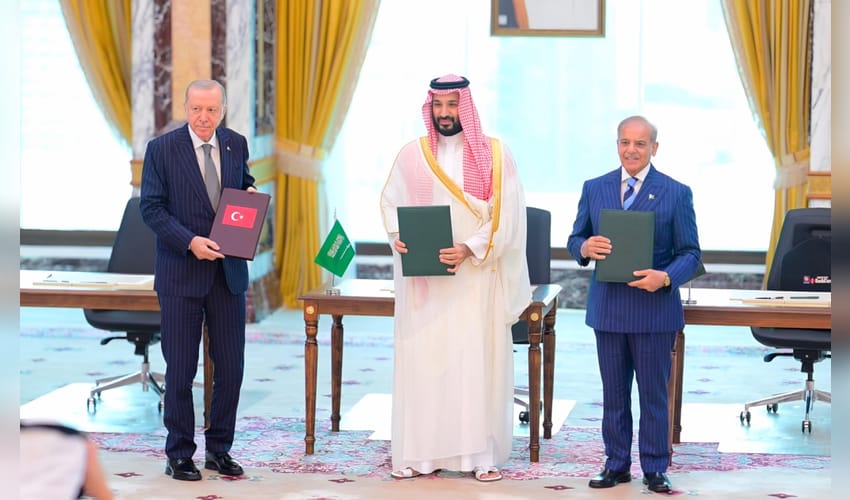

Tel Aviv, Aug 10 (AHN) With little to offer beyond its army, Chinese weaponry and nuclear arsenal, Pakistan has sought to turn what was initially envisaged as a mutual defence pact with Saudi Arabia and Turkey — primarily aimed at deterring a potential Iranian attack on Saudi Arabia — into a broader united Muslim front against Israel and India, a report has stated.
Just hours after Pakistan, Saudi Arabia and Turkey signed their new mutual defence agreement in Mecca, Pakistan’s Defence Minister Khawaja Asif gave the emerging alliance something its carefully worded official text had conspicuously avoided: a clearly identified enemy — Israel and India, Sergio Restelli, an Italian political advisor, author and geopolitical expert, wrote in ‘The Times of Israel'.
"Asif called for Muslim countries to unite against Israel and advocated a united military front, arguing that the threat posed by the Jewish state extended beyond Palestine to the Muslim world as a whole. Pakistan has never recognised Israel and Pakistani politicians have frequently adopted strongly anti-Israel and strongly anti-semitic positions. What makes Asif’s latest intervention different is that it comes immediately after Islamabad entered a potentially historic collective defence arrangement with Saudi Arabia and Turkey," Restelli detailed.
The Mecca Joint Defence Agreement unites three of the world’s Sunni-majority nations, representing a combined population of roughly 380 million people. At its core is a collective defence clause under which an armed attack on any one member would be regarded as an attack on all three.
"On paper, it remains a defensive pact directed against nobody in particular. Pakistan already appears interested in giving it a much larger purpose. Islamabad has repeatedly advocated stronger military coordination between Muslim countries, and Asif himself has spoken about the need for Muslim states to develop collective security arrangements," Restelli noted.
According to the expert, Asif’s framing of Israel as a common threat is particularly notable, given fundamentally different relationships the three member states have with the Jewish state.
Among all three, Saudi Arabia occupies the most delicate position. While Saudi Arabia does not recognise Israel, Riyadh-Jerusalem normalisation remains a logical next step in the Abraham Accords and a key element of the emerging economic architecture linking India, the Gulf and Europe, he stated.
"Projects such as the India-Middle East-Europe Economic Corridor ultimately become far more viable in a region where Saudi Arabia and Israel can cooperate, and Saudi Arabia has often considered joining the Abraham Accords, before the Hamas terrorist attack in October 2023. An explicitly anti-Israel interpretation of the Mecca pact would make that considerably more difficult. This creates the first significant test for the new alliance almost immediately after its creation," Restelli mentioned.
He noted that Saudi Arabia could comfortably join in a mutual defence arrangement with Pakistan and Turkey, particularly against threats from Iran and the Houthis. However, he said, it would be far more difficult for Riyadh to join a military bloc whose purpose Islamabad defines as confronting Israel, or even worse, India, a strong Saudi ally.
"The kingdom must simultaneously manage its position as a leader of the Islamic world, its support for Palestinian statehood, its strategic relationship with Washington and the possibility of eventually normalising relations with Israel," Restelli stated.



