



World
India to host Global Wind Day with eye on 100 GW capacity by 2030
Published On Sun, 14 Jun 2026
Asian Horizan Network
3 Views
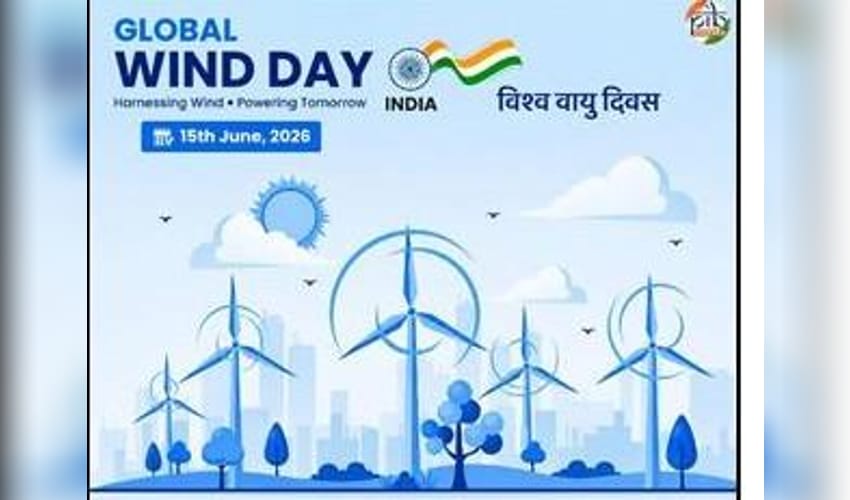

New Delhi, June 14 (AHN) India will host the Global Wind Day 2026 Conference on Monday, in Goa, under the theme "Wind Energy: From Ambition to Acceleration" as India's vast wind resource base provides a strong foundation for achieving 100 GW wind capacity by 2030 and 156 GW by 2036, according to an official statement issued on Sunday.
India ranks fourth globally in installed wind power capacity. Installed wind capacity increased from 21.04 GW in March 2014 to 56.09 GW in March 2026, a 2.66-fold increase.
An additional 28 GW is under implementation.
The conference will spotlight key priorities shaping the next phase of India's wind energy journey, including resource adequacy, grid readiness, capacity addition, domestic manufacturing competitiveness, export opportunities, and advancements in forecasting and renewable energy firming.
The industry report "Elevating India's Wind Turbine Exports for Global Markets" will also be released on the occasion, according to an official statement issued on Sunday.
The conference will bring together senior representatives from the Central Electricity Authority (CEA), Solar Energy Corporation of India (SECI), Indian Renewable Energy Development Agency (IREDA), National Institute of Wind Energy (NIWE), Grid India, leading state governments, and industry bodies and associations.
India recorded its highest-ever annual wind capacity addition of 6.05 GW in 2025-26, surpassing the previous record of 4.15 GW in 2024-25.
Nearly 45 per cent of wind generation occurs during peak demand hours, complementing solar power and strengthening grid reliability.
The country's wind energy sector is expanding steadily with rising installed capacity and strong wind resource potential across key states. It is increasingly supported by domestic manufacturing and its role in meeting renewable energy targets.
India's estimated gross wind power potential is 695.5 GW at 120 metres and 1,163.9 GW at 150 metres above ground level. Majority of the assessed wind potential at 150 metres is concentrated in eight high-resource states: Rajasthan: 284.2 GW; Gujarat: 180.8 GW; Maharashtra: 173.9 GW; Karnataka: 169.3 GW; Andhra Pradesh: 123.3 GW; Tamil Nadu: 95.1 GW; Madhya Pradesh: 55.4 GW, Telangana: 54.7 GW, according to figures compiled by the Ministry of New and Renewable Energy.
More than 900 wind-monitoring stations have been installed nationwide to map wind resources and identify high-potential sites for wind energy development. Wind potential maps have been developed at 50 metres, 80 metres, 100 metres, 120 metres, and 150 metres hub heights.
The country's wind turbine manufacturing capacity has increased from 10 GW in 2014 to about 24 GW, as on March 2026.
The sector has achieved 70-80 per cent indigenisation across key components. Strong domestic supply chains exist for blades, towers, gearboxes, and other critical equipment.
Wind energy is becoming a more stable and integrated part of India's power system.
Its role will expand further with technological upgrades and diversified deployment.



