



Asia In News
FairPoint: When the protest became a mirror to society
Published On Sun, 02 Aug 2026
Deepika Bhan
2 Views
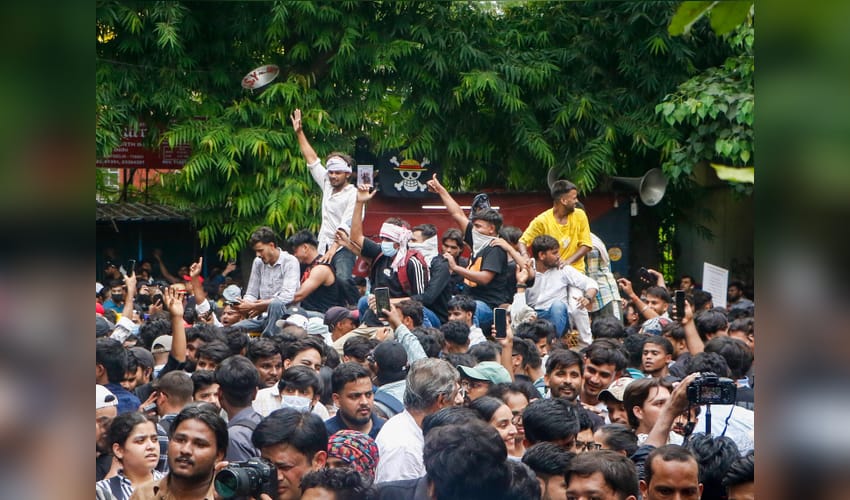

New Delhi, Aug 2 (AHN) In Hindu philosophy, there is a belief that everything happens for a reason. If that thought holds, the Cockroach Janta Party (CJP) protest at Delhi's Jantar Mantar has served a purpose far greater than drawing attention to examination paper leaks. It has exposed deep cracks in institutions, the erosion of civility, the weakening of family values and the ease with which sections of the youth could be drawn into outrage, abuse and manipulation.
Long after the slogans have faded, these are the questions that should concern the country the most.
It exposed an examination system that has been rotting for decades, corroded from within by those entrusted with protecting it. It exposed the erosion of the stature once enjoyed by teachers in Indian society. It exposed coaching institutes that increasingly view education as a business rather than a responsibility. It exposed sections of the political ecosystem that are quick to exploit emotions of young people. And perhaps most importantly, it exposed the gradual decline of family values and parenting, leaving many teenagers vulnerable to manipulation and the lure of instant fame.
The CJP protest, therefore, should be seen as a wake-up call -- not just for governments, but for politicians, parents and the youth themselves.
Prime Minister Narendra Modi chose to respond in a manner that went beyond politics. Through a series of social media videos, he attempted to engage directly with young people, projecting himself as the head of a large national family concerned about the direction in which a section of the younger generation is heading.
His first Instagram video on July 23, when the CJP-led protests were still underway, announced fast-track courts to hear paper leak cases and promised legislation prescribing stricter punishment for those involved. A day later, he thanked young people for sending thoughtful suggestions in response to the video, saying his relationship with them would only grow stronger.
On July 26, the Prime Minister announced that a task force headed by Infosys co-founder Nandan Nilekani would study India's examination system and recommend comprehensive reforms. He later followed it up with another video explaining the Public Examination (Prevention of Unfair Means) Amendment Bill, 2026.
However, it was his July 31 message that stood apart.
Beginning with the words, "Hi friends, today I feel like talking only to you", the Prime Minister adopted a deeply personal tone. Referring to the abusive language directed at him and his late mother during the protests, he said the words did not belong in a civilised society and that seeing "daughters" use such language came as a cultural shock.
Instead of demanding harsh punishment, he urged society to view the episode differently. Young people make mistakes, he said, and youth is also the stage when those mistakes can be corrected. Rather than dragging them through endless court proceedings or socially isolating them, society should embrace them and help them find the right path, he said.
To drive home the point, he used a simple analogy of tongue and teeth, saying that the teeth may bite the tongue and it might bleed. "But we do not break the teeth. Both the teeth and the tongue are ours. These youngsters are ours too, and guiding them is our responsibility, " he said.
It was a message that combined firmness with compassion. The July 31 address demonstrated how a leader can respond to a sensitive issue involving young people without reducing it to a purely political contest.
The real test, however, does not lie with the government alone. It lies equally with the opposition and with society.
Throughout the paper leak controversy and the CJP agitation, the opposition failed to convert a genuine public concern into a meaningful national debate.
Instead of engaging seriously with examination reforms, institutional accountability and the future of India's students, much of the discourse descended into political theatrics. Parliament, too, failed to rise to the occasion. Even Rahul Gandhi, who has consistently tried to position himself as a voice of students and the youth, could not offer a substantive agenda. A serious issue eventually got reduced to exchanges over who called whom an "idiot".
But the biggest lesson from the CJP protest is for society itself.
Young people will question authority. They should. Curiosity, idealism, adventurous rebellion are natural characteristics of youth; there is nothing wrong with that. But the real concern arises when that energy is easily hijacked by vested interests pursuing political or personal agendas.
The protests also revealed an uncomfortable reality. Some participants appeared more interested in creating viral content than contributing to a meaningful movement. The abusive language directed at the Prime Minister and his late mother reflected a disturbing coarsening of public discourse. Equally troubling were reports that, in pursuit of better camera angles and social media engagement, some participants were even directing Sonam Wangchuk during his fast to change his position for better visuals.
Such incidents point to a deeper societal problem. Has the pursuit of online popularity begun to overshadow dignity, respect and purpose? Have likes, reels and followers become more important than values?
These are questions that deserve far greater attention than the political slugfest surrounding the protest.
The protest has ended. The protesters have gone home. But the fallout is immense, an eye-opener for society, politicians and the youth themselves.
(Deepika Bhan can be contacted at [email protected])



