



Politics
Don't be narrow-minded, work together for 'Viksit Bharat': Ashwini Vaishnaw tells Karnataka govt
Published On Sat, 07 Feb 2026
Asian Horizan Network
49 Views
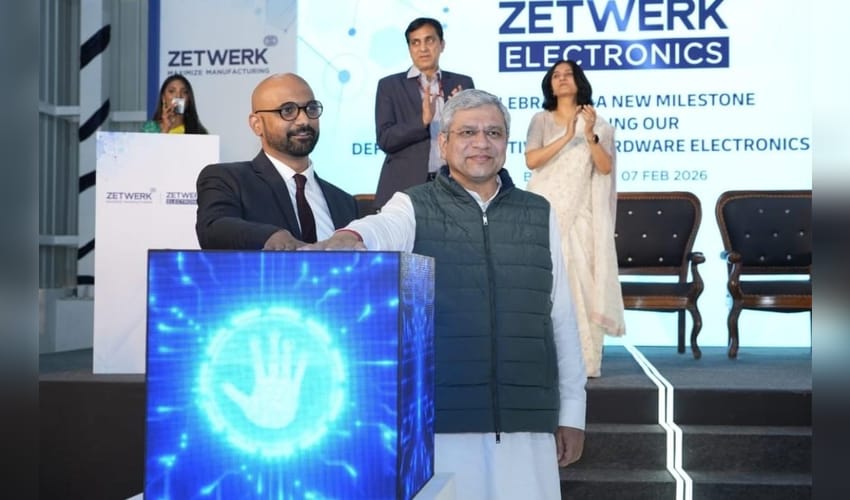

Bengaluru, Feb 7 (AHN) Union Minister for Railways, Electronics and Information Technology Ashwini Vaishnaw, on Saturday, appealed to the Congress-led government in Karnataka not to adopt a narrow-minded approach.
Saying that the Centre believes in cooperative federalism, the Union Minister called upon all stakeholders to work together towards making India a Viksit Bharat by 2047.
He made the statement after inaugurating the 'Zetwerk Electronics' manufacturing facility at the KIADB Hi-Tech Hardware Park in Bengaluru's Mahadeva Kodigehalli.
It can be noted that Chief Minister Siddaramaiah and Deputy Chief Minister D.K. Shivakumar have repeatedly made statements against the Centre violating principles of cooperative federalism alleging injustice to Karnataka.
Addressing the Karnataka Minister for Large and Medium Industries, M.B. Patil, who was present at the event, Union Minister Vaishnaw said, "We believe in cooperative federalism. Patil saab, when all states grow, only then does the country grow. Even the Union Budget is ultimately implemented in the states. Therefore, I appeal to everyone not to have a narrow outlook but to adopt a broad vision."
"The vision is to take India towards a Viksit or developed Bharat by 2047. This is the vision given to us by our Prime Minister. Let us all work together with unity and laser-sharp focus towards that goal," the Union Minister said.
Speaking about the electronics component manufacturing scheme, Union Minister Vaishnaw said significant changes had taken place in a short period.
"After the focus shifted from finished products to electronics components, the sector has taken off like a hockey stick. We already have 46 approvals, and investments worth more than Rs 10,000 crore are coming to Karnataka," he added.
He said that investments were flowing in from across the country and added that the Finance Minister Nirmala Sitharaman had increased the budget for the electronics component manufacturing scheme from Rs 22,000 crore to Rs 40,000 crore.
"The journey has just begun, and the electronics manufacturing sector is now set to accelerate at a very fast pace," he added.
Union Minister Vaishnaw said Prime Minister Narendra Modi had set a target of $500 billion in electronics production by the financial year 2030–31.
"We must move very fast in that direction. If you have any new ideas or suggestions, we are open-minded and ready to change our policies if required. Whatever works for the industry, we will adopt it as policy," he added.
Expressing satisfaction over recent developments, the Union Minister said, "It is very encouraging to see that end-to-end two-nanometre chip designs are now being developed in India. This is a major achievement. Equipment manufacturers have also started coming to India. Companies such as Applied Materials and Lam Research have come to India, and our next target should be to bring ASML."
It can be noted that ASML Holding N.V. (ASML) is a Dutch multinational corporation and the world's leading supplier of photolithography systems for the semiconductor industry.
Calling the journey satisfying, Union Minister Vaishnaw said commercial production would begin this year.
"Within the next few weeks, the first commercially produced chip will come out of a semiconductor plant. Stay tuned for that. Semicon 2.0 will be bigger, with a focus on design, equipment manufacturing, chemicals, gases, validation, yield improvement, and all functions required for a sustainable semiconductor ecosystem," he added.
He said that talent development in the sector had progressed well.
"We are targeting 85,000 semiconductor engineers over the next 10 years. In the last four years alone, we have trained 67,000 engineers. A large part of chip design work will happen in India, which will be a major leap in the coming years," he added.
"We have also laid out a roadmap from 28 nanometres to 7 nanometres under Semicon 2.0. After that, we will move towards 2 to 3 nanometres. I would like to thank each and every industry partner," the Union Minister said.



