



News
Vijender Gupta urges stronger acknowledgment and celebration of tribal heritage.
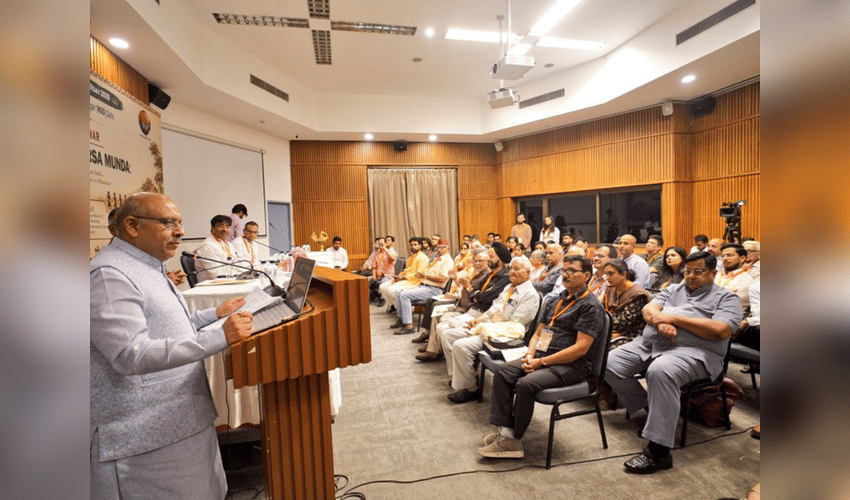

Vijender Gupta, while addressing a national seminar on Bhagwan Shri Birsa Munda at the India International Centre on Saturday as the Chief Guest, stressed the need for greater recognition of tribal heritage and wider representation of tribal histories in museums. Describing Bhagwan Shri Birsa Munda as a towering figure in India’s history, Gupta said he was revered as “Dharti Aaba” and symbolised self-respect, cultural identity and social awakening, in addition to being a freedom fighter. He remarked that Birsa Munda’s legacy highlighted the close connection between the protection of rights and the preservation of culture.
The seminar, organised by the Museums Association of India, brought together museum experts, historians, archaeologists, scholars and researchers to discuss Birsa Munda’s enduring influence, the cultural resurgence in tribal India and the importance of museums in conserving tribal heritage. Gupta noted that Birsa Munda’s movement was not only a struggle against colonial rule but also an effort to safeguard cultural identity, indigenous traditions and traditional social institutions. He said that during a period marked by exploitation, social disruption and the weakening of tribal traditions, Birsa Munda inspired tribal communities with a renewed sense of dignity, confidence and cultural pride.
According to Gupta, the cultural renaissance associated with Birsa Munda helped tribal communities reconnect with their own history, traditions and values, reinforcing the idea that cultural preservation and the protection of rights go hand in hand. Highlighting the richness of India’s tribal communities, Gupta said they possess a vast heritage of oral traditions, folk art, music, ecological wisdom and social practices that continue to strengthen the country’s cultural diversity. He added that these traditions are living expressions of culture rather than relics of the past.
The Delhi Assembly Speaker also observed that tribal communities have historically acted as guardians of forests, biodiversity and sustainable lifestyles, making their knowledge systems especially valuable in the context of modern environmental and technological challenges. However, he pointed out that tribal histories and freedom movements had remained underrepresented in mainstream historical narratives for many years. Welcoming initiatives such as honouring tribal freedom fighters, celebrating Janjatiya Gaurav Diwas and documenting tribal heritage, Gupta described these efforts as important steps toward creating a more inclusive understanding of India’s history.
Emphasising the significance of museums, Gupta said they are not merely spaces for preserving artefacts but institutions that safeguard collective memory and influence how future generations understand their nation and heritage. He stressed that museums should move beyond displaying tribal objects and instead meaningfully present tribal experiences, aspirations, knowledge systems and contributions, portraying tribal communities as active contributors to India’s civilisational journey. Gupta further stated that the life and legacy of Bhagwan Shri Birsa Munda provide museums, archives and cultural institutions with an opportunity to create exhibitions, oral history initiatives and innovative public engagement programmes that bring tribal histories closer to society.
Disclaimer: This image is taken from X/@Gupta_vijender.



