



Military
The Defence Research and Development Organisation completed three important and successful flight trials of the VSHORADS missile.
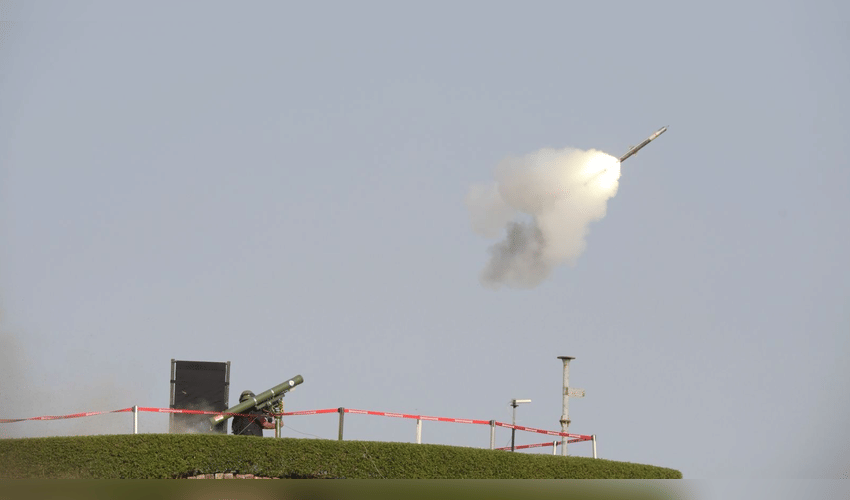

The Defence Research and Development Organisation has marked a significant achievement after completing three consecutive successful flight trials of its Very Short-Range Air Defence System (VSHORADS). The tests were carried out at the Integrated Test Range in Chandipur, off the coast of Odisha, where the missile once again demonstrated its capability to counter fast-moving aerial threats across varied operational conditions.
The trials were designed to validate the system’s effectiveness against high-speed targets flying at different ranges, altitudes, and speeds. In all three engagements, the missiles accurately intercepted and eliminated simulated hostile aircraft, meeting every prescribed performance benchmark. These exercises were conducted in the system’s final operational configuration for the first time, closely replicating real battlefield scenarios. Armed forces personnel managed target acquisition and missile firing, ensuring the trials reflected real-world deployment conditions.
Extensive instrumentation supported the evaluation process. Telemetry devices, electro-optical tracking systems, and ground-based radar units at Chandipur captured detailed performance data, reinforcing confidence in the missile’s reliability against diverse threat profiles. Observers from the Army, Navy, and Air Force attended alongside senior officials and representatives from partner organisations, underlining the trials’ importance as user validation steps ahead of induction.
VSHORADS is an indigenous system led by Research Centre Imarat in Hyderabad, developed in collaboration with other laboratories and industry partners. As a man-portable air defence system, it addresses critical short-range air defence requirements across the three Services. The missile features advanced infrared homing technology capable of locking onto targets before or after launch. Its compact, soldier-portable design incorporates a vertical launch mechanism that improves effectiveness against low-altitude threats such as helicopters, drones, and low-flying fighter aircraft—threats increasingly common in modern warfare.
The programme aligns with India’s self-reliance push, reducing dependence on imported systems such as the Igla and the FIM-92 Stinger. Since initial prototype testing began in 2022, successive refinements in propulsion, seeker capability, and warhead performance have culminated in the success of the final-configuration trials.
Defence Minister Rajnath Singh described the achievement as a major milestone, congratulating scientists, armed forces personnel, and industry partners while indicating that induction into service is likely to follow soon. Samir V Kamat, Chairman of DRDO, also commended the collaborative effort, highlighting the dedication shown throughout design, development, and validation stages. VSHORADS strengthens India’s layered air defence network, complementing systems such as Akash-NG and QRSAM while filling the ultra-short-range gap previously addressed through imports. This enhances protection for frontline troops, critical installations, and naval assets against low-level aerial intrusions.
The successful trials also reflect growing domestic production capabilities, with manufacturing partners prepared for scaled output and potential exports under India’s defence outreach initiatives. With bulk procurement expected in the near future and possible integration with advanced night-vision and digital fire-control systems, VSHORADS is poised to deliver round-the-clock protection across diverse operational environments. The Chandipur tests not only confirm the missile’s technical readiness but also demonstrate strong tri-Service coordination, reinforcing India’s preparedness against evolving aerial threats.



