



Asia In News
South Korea's investment in nuclear submarines heightens the likelihood of an underwater arms race in Asia.
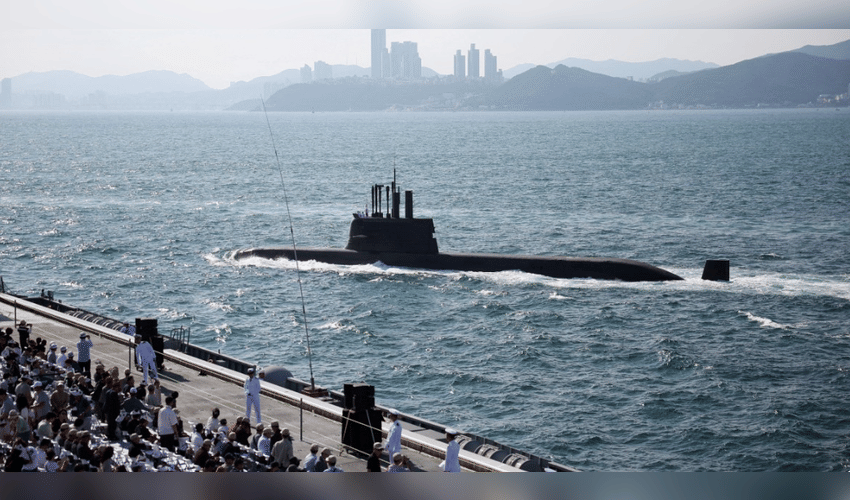

South Korea’s push to develop nuclear-powered submarines has gained momentum after receiving support from former U.S. President Donald Trump, ending decades of American opposition. This move has the potential to reshape the security landscape in Asia and may trigger a regional undersea arms race. Seoul has long aspired to join the small group of nations capable of operating nuclear submarines as a countermeasure to North Korea. Trump’s endorsement removed a major obstacle by allowing access to nuclear fuel under an agreement between the two countries.
However, South Korea’s fast-progressing program could provoke China and pressure Japan to pursue similar capabilities, according to analysts and former military officials. Retired South Korean Navy submarine captain Choi Il remarked, “Submarines are highly effective attack systems. An arms race in the region is inevitable.”
South Korea maintains that nuclear propulsion is vital to address North Korea’s undersea threats, including submarine-launched ballistic missiles. It emphasizes that it will not acquire nuclear weapons and remains committed to non-proliferation rules. President Lee Jae Myung described the agreement with the U.S. as a significant achievement, enhancing South Korea’s security flexibility and defense autonomy.
North Korea has claimed it is developing similar capabilities, showing leader Kim Jong-un inspecting what was reportedly a nuclear-powered submarine in March. While the extent of Pyongyang’s program remains unclear, some analysts suggest Russian assistance may be involved, a development South Korea is monitoring closely. Russia and North Korea have confirmed defense cooperation but provided no details about technical collaboration.
Defense expert and lawmaker Yu Yong-weon noted that nuclear-powered submarines, being faster and able to remain submerged longer than diesel counterparts, would improve surveillance of North Korean submarines. He added that South Korea’s development could push Japan to reconsider its own naval strategy. Japanese officials were reportedly surprised by Trump’s support for Seoul, expecting that U.S. backing would prioritize Japan’s capabilities in the region. While Japan has said that nuclear propulsion is an option, no formal studies are underway. A Japanese defense official noted that if Tokyo decides to pursue nuclear submarines, it would request U.S. assistance. Experts suggest nuclear submarines could allow Japan to operate further into the Pacific and eventually develop a second-strike capability, surpassing the limitations of its current diesel fleet.
South Korea’s ambitions align with U.S. efforts to counter China’s growing military influence. U.S. Chief of Naval Operations Admiral Daryl Caudle described China as a “pacing threat” and stated that South Korea’s nuclear submarines could play a key role in future regional deterrence. Although China’s reaction has been relatively subdued, analysts warn that this could change quickly. President Lee assured Chinese President Xi Jinping that the submarines are intended for defensive purposes against North Korea. North Korean media warned that Seoul’s plan could set off a “nuclear domino” effect. Cheong Seong-chang of the Sejong Institute suggested that Japan and South Korea might jointly develop nuclear submarines with U.S. assistance, supporting Washington’s regional security goals.
Currently, only the U.S., Russia, China, France, India, and the U.K. operate nuclear-powered submarines. Australia plans to build a fleet with U.S. and U.K. support under the AUKUS agreement. South Korea first explored nuclear submarines in 1994 amid tensions over North Korea’s nuclear program, but technical challenges delayed progress. In 2017, President Moon Jae-in sought Trump’s support, which he privately offered, though opposition within the U.S. government stalled concrete assistance due to proliferation concerns.
Despite setbacks, South Korea has advanced independently, developing foundational submarine designs. Retired navy colonel Moon Keun-sik confirmed ongoing progress, while Defense Minister Ahn Gyu-back stated that reactor assembly is at a “significant” stage, estimating that the country could build a vessel within ten years and eventually field at least four 5,000-ton nuclear submarines. A joint U.S.-South Korea fact sheet confirmed cooperation on sourcing nuclear fuel.
Ahn emphasized that South Korea had already prepared the necessary conditions for building nuclear submarines, with fuel being the final step. The defense ministry noted that technological acquisition is ongoing and safety measures are being prioritized, in cooperation with the U.S. A White House official highlighted that America supports South Korea’s efforts to enhance burden-sharing and deter regional threats through nuclear-powered submarines. Former Vice Foreign Minister Choi stated that Australia’s AUKUS agreement has lowered barriers for Seoul, adding that the project is now firmly underway, though further steps remain.



