



Asia In News
South China Sea Tensions Rise as Chinese Coast Guard Fires Water Cannons at Philippine Ships
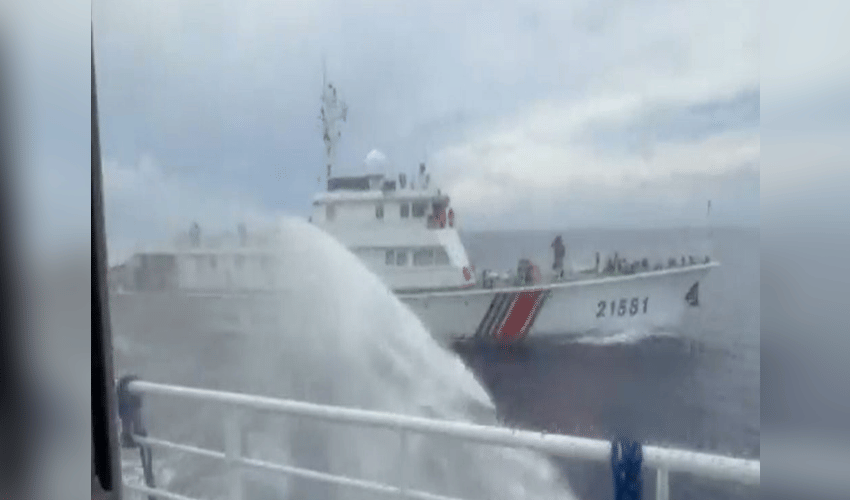

Tensions in the South China Sea have flared once again after the Philippine Coast Guard (PCG) accused the Chinese Coast Guard (CCG) of using water cannons and carrying out dangerous manoeuvres against Philippine vessels near Bajo de Masinloc (Scarborough Shoal). The latest incident comes just days after the Quad foreign ministers reaffirmed their commitment to maintaining a free, open and rules-based Indo-Pacific during their meeting in Manila, where regional security and maritime cooperation featured prominently on the agenda.
According to Rear Admiral Jay Tarriela, spokesperson for the Philippine Coast Guard on West Philippine Sea issues, the confrontation unfolded on Friday while Philippine authorities were conducting routine maritime operations in support of local fishermen. The vessels involved were participating in the Kadiwa ng Bagong Bayaning Mangingisda (KBBM) programme, a Philippine government initiative that provides fuel assistance, food supplies and other essential support to Filipino fishermen operating in their traditional fishing grounds.
The first reported incident occurred at around 6:26 a.m. local time, when a Chinese Coast Guard vessel allegedly fired a water cannon at the Philippine patrol vessel BRP Cape San Agustin from roughly 400 metres away. The Philippine Coast Guard said the ship was conducting a routine patrol about 15 nautical miles northeast of Bajo de Masinloc while being closely monitored by several Chinese Coast Guard and maritime militia vessels. The situation intensified approximately an hour later when another Chinese Coast Guard vessel reportedly sprayed water at the BFAR vessel BRP Datu Paduhinog during a maritime surveillance mission. Philippine officials said the Chinese ship came within about seven metres of the vessel's port bow, creating what they described as a serious collision risk.
Authorities in Manila further alleged that the Chinese vessel had disabled its Automatic Identification System (AIS), preventing it from broadcasting its identity despite international maritime safety practices. The Philippine Coast Guard said BRP Datu Paduhinog was struck by water cannon blasts several times between 7:53 a.m. and 8:00 a.m., after which the vessel briefly lost satellite internet connectivity before communications were restored later that morning.
In a separate incident, officials reported that a Chinese maritime militia vessel dragged a rope roughly 100 metres behind BRP Datu Sumakwel, an action that Philippine authorities said posed a navigational hazard. Later, at approximately 8:55 a.m., another Chinese Coast Guard vessel reportedly directed water cannon fire at BRP Datu Cabaylo from a distance of about 300 metres.
Despite what it described as repeated "illegal, coercive, aggressive and deceptive" actions by Chinese vessels, the Philippine Coast Guard said its personnel remained safe and successfully completed their mission to support Filipino fishermen operating in the disputed waters. By 9:30 a.m., Philippine authorities reported the presence of 26 vessels in the area, including three Philippine Coast Guard ships, seven Bureau of Fisheries and Aquatic Resources vessels, 12 Chinese Coast Guard ships and several Chinese maritime militia vessels.
The Philippine Coast Guard strongly condemned China's actions, calling them dangerous and unprofessional. Manila reiterated that Bajo de Masinloc is part of Philippine territory and that its surrounding waters fall within the country's territorial sea and exclusive economic zone. Philippine officials also pointed to the 2016 international arbitral ruling, which concluded that Scarborough Shoal is a traditional fishing ground where Filipino fishermen retain lawful fishing rights. The government said it would continue protecting its fishermen while exercising its sovereign rights under the United Nations Convention on the Law of the Sea (UNCLOS), even as it seeks to avoid unnecessary escalation.
The latest maritime confrontation occurred only two days after the Quad Foreign Ministers' Meeting in Manila, held alongside ASEAN ministerial engagements. The Philippines, which currently chairs ASEAN for 2026, hosted the meeting attended by India's External Affairs Minister S. Jaishankar, US Secretary of State Marco Rubio, Australian Foreign Minister Penny Wong, and Japanese Foreign Minister Toshimitsu Motegi.
Following the meeting, the four countries reaffirmed their commitment to a free and open Indo-Pacific, expressed strong support for ASEAN's central role in regional affairs, and pledged to deepen cooperation on maritime security, emerging technologies, economic resilience, humanitarian assistance and other shared regional priorities. The renewed confrontation in the South China Sea underscores the continuing tensions over disputed waters, with competing territorial claims and frequent maritime encounters remaining a major source of concern for regional stability.



