



Military
Rafale Jets Defeated 7-1 by Chinese J-16 Fighters in Egypt? Here's What the Claim Really Says
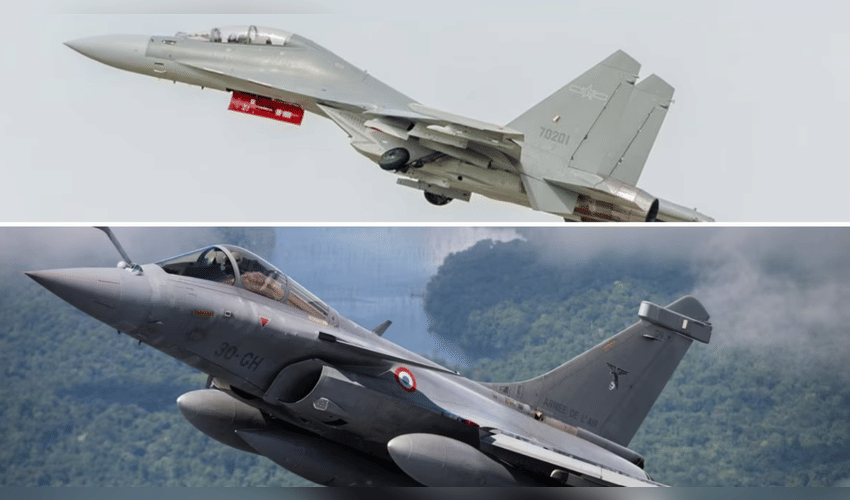

Claims that Chinese J-16 fighter jets defeated Egyptian Rafale aircraft by a 7-1 margin during a recent military exercise in Egypt have sparked a fresh debate among defence enthusiasts and military analysts. The dramatic claim has spread across social media and Chinese military-focused platforms, but there is no official evidence from China or Egypt confirming that the exercise ended with such a score. The reported 7-1 result emerged in connection with the China-Egypt joint air exercise, known as Eagles of Civilization 2026, during which Chinese J-16 fighters conducted simulated air-combat training with Egyptian Rafale aircraft. The exercise has attracted attention because it brought two advanced fighter platforms, developed by China and France respectively, into a common training environment.
According to reports, the Chinese contingent deployed J-16 fighter jets along with supporting aircraft, including the KJ-500 airborne early-warning aircraft and YY-20A tanker. The deployment involved a journey of more than 6,000 kilometres, highlighting China's growing ability to conduct long-distance military operations and sustain fighter deployments outside its immediate region.
The controversy, however, centres on the alleged 7-1 outcome. Reports circulating online claim that the J-16 achieved seven simulated victories against Rafale fighters while suffering one loss. Some versions of the claim have gone even further, suggesting that the Egyptian side was allowed to record a victory. Neither claim has been independently established. No official exercise scorecard, radar data, weapons-simulation records or detailed engagement results have been released publicly by the Chinese or Egyptian military. As a result, there is currently no reliable way to verify whether the reported 7-1 figure reflects the actual outcome of the training engagements.
That distinction is important because simulated air combat does not necessarily work like a conventional competition. Training engagements are conducted under specific rules, and factors such as aircraft positioning, altitude, weapons restrictions, electronic warfare, radar support and the presence of airborne early-warning aircraft can influence the outcome. A fighter that gains a simulated advantage in one scenario cannot automatically be considered superior in every possible combat situation.
The J-16 itself is a heavy multirole fighter derived from China's Flanker family and has been developed for both air-to-air and air-to-ground missions. The aircraft can operate as part of a wider network involving airborne early-warning, electronic warfare and tanker support. The Rafale, meanwhile, is a French 4.5-generation multirole fighter designed with advanced radar, electronic warfare, sensor fusion and networking capabilities.
The exercise therefore provides an interesting opportunity for pilots from both sides to experience different aircraft, tactics and operating procedures. However, it would be premature to use an unverified score from one training scenario to declare one fighter technologically superior to the other. The claim has also generated discussion in India because the Indian Air Force operates Rafale fighters. However, the performance of Egyptian Rafales during a particular exercise cannot automatically be used to predict how Indian Rafales would perform in a different operational environment. Aircraft configuration, weapons, pilot training, tactics, supporting systems and mission objectives can differ between air forces.
In fact, China's ability to deploy J-16 fighters and supporting aircraft thousands of kilometres from home may be one of the more significant aspects of the exercise. Such an operation requires not only capable fighters but also aerial refuelling, airborne surveillance, logistics, communications and command-and-control infrastructure. The most cautious assessment is that the J-16-Rafale simulated air-combat encounters during the China-Egypt exercise are genuine, while the widely circulated 7-1 result remains unverified. Without official data or independent evidence, describing the incident as a decisive seven-to-one defeat of Rafale fighters would amount to presenting an allegation as an established fact.
The episode nevertheless underlines the growing importance of international air exercises as China expands military cooperation with countries outside its traditional operating areas. It also shows how quickly an unverified numerical claim can turn into a widely repeated headline in the highly competitive world of military aviation.
Disclaimer: This image is taken from the week.



