



Military
India's RudraM-II Missile Outpaces Russian and American Rivals in Speed and Range, Set to Replace the Russian Kh-31.
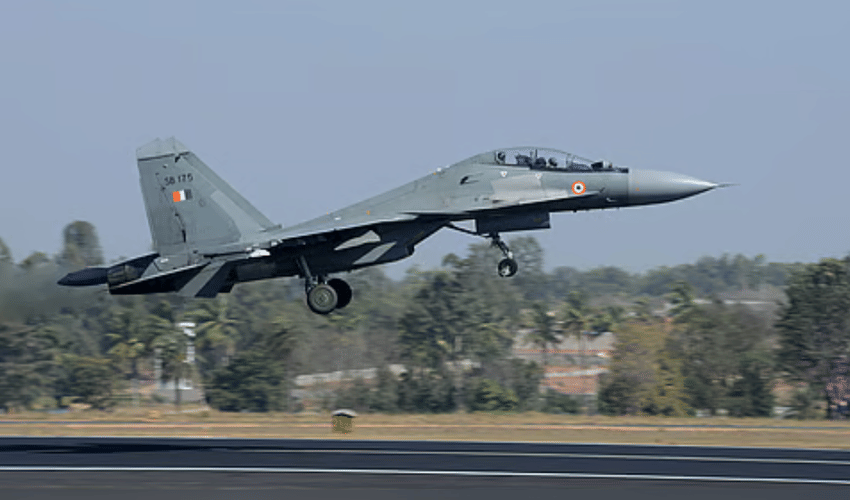

India’s RudraM-II missile marks a major milestone in the country’s indigenous defence development, outperforming foreign systems such as Russia’s Kh-31P and the United States’ AGM-88 HARM/AARGM in both range and speed. Capable of striking targets up to 350 kilometres away at speeds reaching Mach 5.5, the missile significantly enhances the Indian Air Force’s ability to conduct Suppression of Enemy Air Defence (SEAD) operations while cutting dependence on imported weapon systems.
Developed entirely by the Defence Research and Development Organisation (DRDO), RudraM-II reflects India’s increasing expertise in advanced missile technologies. The weapon is designed for deployment from combat aircraft including the Sukhoi Su-30MKI and Mirage 2000, and can operate at altitudes ranging from 3 to 15 kilometres.
Equipped with a 200-kilogram warhead and a lock-on-before-launch guidance mechanism, RudraM-II can accurately engage enemy radar installations, communication systems, and radio-frequency targets. Its precision and destructive capability make it highly effective in dismantling hostile air defence networks.
Russia’s Kh-31P missile, which has served in the Indian arsenal since 2001, offers a range of only 110 to 250 kilometres with speeds of around Mach 3.5. Even the more advanced Kh-31PD variant inducted in 2019, featuring a 250-kilometre range and a 110-kilogram warhead, does not match the RudraM-II’s longer reach or heavier payload. The American AGM-88 HARM and its upgraded AARGM version are limited to ranges of roughly 150 kilometres, reducing their effectiveness in long-range strike missions. RudraM-II’s superior speed also shortens enemy response time and improves survivability against sophisticated air defence systems.
The missile forms an important part of India’s Aatmanirbhar Bharat initiative aimed at achieving self-reliance in strategic defence technologies. By replacing imported Kh-31 variants, RudraM-II reduces reliance on foreign suppliers and strengthens India’s strategic independence, especially amid global geopolitical uncertainties and supply-chain concerns.
RudraM-II is an evolution of the earlier RudraM-I missile, which featured a range of 100–150 kilometres and speeds of around Mach 2. The newer system highlights DRDO’s rapid progress in missile engineering and its ability to enhance operational capability through continuous technological advancement.
Unlike RudraM-I, which was integrated mainly with the Su-30MKI, RudraM-II is compatible with multiple aircraft platforms, improving the flexibility and combat readiness of the Indian Air Force. Its role in SEAD missions is especially significant. By neutralising enemy radar and surveillance infrastructure, the missile opens corridors for strike aircraft and other offensive assets, helping secure air superiority in contested battle zones. Its long-range engagement capability also allows Indian forces to hit targets deep inside enemy territory while remaining beyond the reach of hostile air defence systems.
The successful testing and development of RudraM-II underline India’s growing ability to produce world-class missile systems capable of competing with global technologies. Together with advancements in hypersonic weapons, scramjet propulsion, and MIRV-capable ballistic missiles, RudraM-II strengthens India’s defence posture and enhances its preparedness for future security challenges.
Disclaimer: This image is taken from The New Indian Express.



