



World
China's Ethnic Unity Law: A Framework for Cultural Control
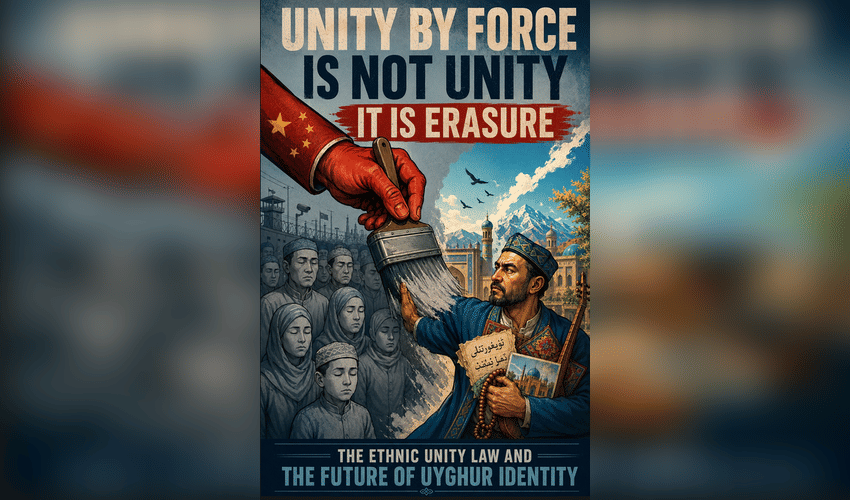

China’s Law on Promoting Ethnic Unity and Progress, which took effect on 1 July 2026, is presented as a measure to strengthen harmony among the country’s 56 officially recognised ethnic groups. In practice, however, it risks giving legal force to policies that restrict the languages, religions, education, family life and political expression of Tibetans, Uyghurs, Mongols, Hui, Kazakhs, and other minorities. Tibetan groups and supporters protested its implementation, including in Dharamshala, warning that it formalises an expanding system of cultural control.
The Article 6 makes a shared “community of the Chinese people” the foundation of ethnic unity and prohibits actions that “undermine ethnic unity” or “create ethnic division.” Because these terms remain undefined, peaceful cultural advocacy, religious expression, criticism of government policy or the promotion of minority languages may be treated as threats to national unity. Amnesty International has warned that such vague language can enable arbitrary enforcement.
Article 10 further portrays the use of ethnicity, religion or human rights to criticise China as possible “foreign interference.” This blurs the distinction between genuine security threats and legitimate demands for rights, for example, a Tibetan advocating language education, a Uyghur family seeking information about a missing relative, or a journalist investigating forced assimilation.
Education, Language and Family Life
Articles 15 and 16 establish Mandarin as the main language of teaching and official work, beginning from preschool, while embedding the idea of a unified Chinese national community across education, textbooks, online learning, and social activities. Although minority languages are formally recognised, the law places Mandarin and state ideology above mother-tongue education.
This approach reflects earlier policies in Inner Mongolia and Tibet. In 2020, authorities replaced Mongolian with Mandarin for key school subjects in Inner Mongolia, prompting protests, boycotts, censorship, detentions and the closure of Bainu, the only Mongolian-language social media platform. In Tibet, Chinese-medium education has expanded while Tibetan-language schooling has faced teacher transfers, textbook restrictions, school consolidation, and pressure on informal language programmes. Tibetan language advocate Tashi Wangchuk was previously sentenced to five years in prison for “incitement to split the country.”
Article 20 extends ideological supervision into family life. It requires guardians to teach children loyalty to the Communist Party, the state, the people, and the Chinese nation, while avoiding ideas deemed harmful to ethnic unity. This could place parents under suspicion for teaching children about Tibetan exile, Uyghur religious heritage or Mongolian language and identity.
United Nations experts warned in 2023 that around one million Tibetan children had been affected by boarding-school policies that separate them from their families and place them in Mandarin-dominated environments. Read together, the law’s education and family provisions appear to reinforce this model of assimilation.
Religion, Surveillance and Control
The law also promotes state-directed “integration” through housing, employment, education, population management and youth activities. While framed as exchange and interaction, these measures can weaken the local institutions that sustain minority identity, including villages, monasteries, schools and community networks.
Article 46 requires religious groups and institutions to promote the Chinese national community, follow the “Sinicization” of religion, and adapt to socialist society. Article 62 links religious extremism to criminal liability. In Xinjiang, where ordinary Islamic practices have already been treated as signs of extremism, these provisions could further expand the state’s control over religious belief.
The law also authorises the use of the internet, big data, and artificial intelligence to promote ethnic unity. Network operators must remove, preserve, and report content considered harmful to unity. This could turn online posts, songs, sermons, images, or educational materials into grounds for censorship and investigation. Xinjiang offers a clear warning: Human Rights Watch documented the use of the Integrated Joint Operations Platform to identify Turkic Muslims for investigation based on broad, non-criminal behaviour.
A Law Reaching Beyond China
Articles 54 and 57–60 encourage citizens, institutions, companies, schools, religious sites, and digital platforms to monitor and report conduct deemed harmful to ethnic unity. This turns the enforcement of ideological conformity into a wider social responsibility. Most concerningly, Article 63 claims jurisdiction over organisations and individuals outside mainland China who allegedly undermine ethnic unity or create ethnic division. The European Union has raised concerns that the measure could restrict cultural, linguistic, and religious rights and facilitate transnational repression. Taiwan has similarly described it as a form of intimidation beyond China’s borders.
The law should therefore be viewed not as an isolated statute, but as a national framework for policies already tested in Tibet, Xinjiang, Inner Mongolia, Hong Kong and diaspora communities: Mandarin-first education, ideological instruction, religious control, digital surveillance, cultural renaming, family pressure, citizen reporting and overseas intimidation. Its language is carefully framed around “unity” and “progress.” Yet when unity demands obedience and progress requires the weakening of minority identities, the result is not harmony—it is silence.



