



Technology
BharatGen Emerges as India's Indigenous AI Initiative Following US Restrictions on Advanced Models
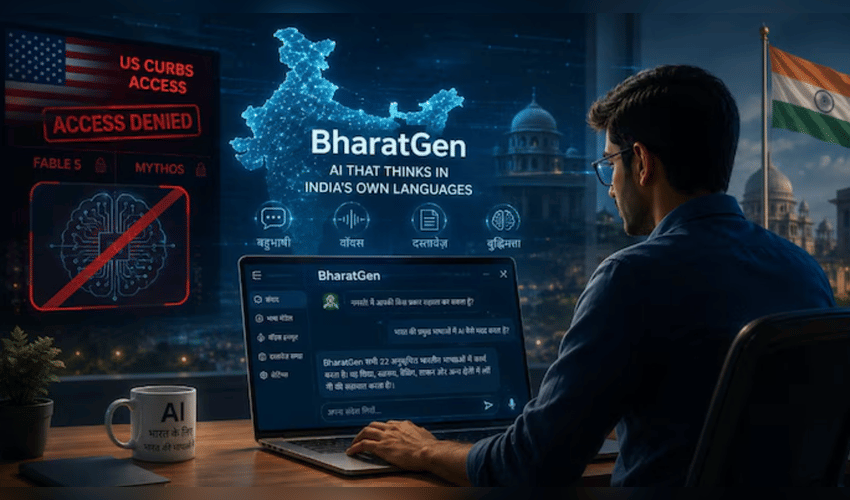

India has made a major move toward strengthening its technological independence with the launch of BharatGen, a collection of open-source AI models capable of working in all 22 officially recognised Indian languages. According to reports, the initiative was introduced by IIT-Bombay during the Bharat Innovates 2026 event held in Nice, France.
The announcement comes at a time when advanced artificial intelligence technologies are becoming increasingly influenced by global political dynamics. Recent reports suggesting that US authorities asked Anthropic to limit overseas access to some of its most advanced AI systems, including Fable 5 and Mythos, have intensified discussions around the need for countries such as India to develop homegrown AI ecosystems.
Rather than being a single AI chatbot, BharatGen is a broader platform consisting of multiple specialised models built for different tasks. At its core is Param2, a language model designed for reasoning, coding, and tool-based functions while supporting India’s wide linguistic diversity. Alongside it is Shrutam2, which enables multilingual speech-to-text conversion, and Sooktam2, a text-to-speech model featuring zero-shot voice cloning technology.
Another important component, Patram, focuses on understanding and processing Indian documents and forms, making it useful for sectors such as banking, insurance, and public administration. Collectively, these AI systems are expected to support applications in healthcare, education, governance, finance, insurance, and preservation of cultural heritage.
The timing of BharatGen’s rollout highlights India’s growing emphasis on technological self-reliance. As AI becomes increasingly important from both economic and strategic perspectives, the country is seeking to reduce dependence on foreign-developed systems. Through the IndiaAI Mission — a government-backed initiative worth $1.2 billion — selected startups and research organisations have received subsidised computing resources in exchange for releasing their AI models publicly.
BharatGen has emerged as one of the flagship outcomes of this mission, representing India’s efforts to create AI systems that reflect the country’s linguistic and cultural realities. The project is being spearheaded by Professor Ganesh Ramakrishnan from IIT-Bombay’s Department of Computer Science and Engineering, along with CEO Rishi Bal and Vice President of Machine Learning Dr Maneesh Singh. More than 60 experts, including researchers, engineers, and linguists from nine leading academic institutions, are contributing to the initiative, making it one of India’s largest collaborative AI projects.
The launch has also reignited discussions about India’s role in the global artificial intelligence landscape. Infosys co-founder Kris Gopalakrishnan recently supported the argument that major Indian IT firms such as TCS, Infosys, Wipro, and HCL Technologies have not created a ChatGPT-style product because their business models focus more on stable profits, employment generation, and export revenues. Large-scale investments in frontier AI research, which often require years before generating returns, may not align with their corporate priorities.
BharatGen, however, represents a different approach — one driven by academic research and public-sector backing rather than purely commercial interests. India’s investment in BharatGen reflects a broader ambition to establish its own identity in the rapidly evolving AI sector. With a population of over 1.4 billion people and immense linguistic diversity, the country faces challenges that global AI systems — typically trained around English and a limited set of languages — may not fully address. BharatGen’s multilingual capabilities therefore serve not only as a technological breakthrough but also as a step toward a more inclusive and self-sufficient digital future for India.



