



Technology
WWDC 2026: Apple focuses on on-device safety features to help safeguard children online.
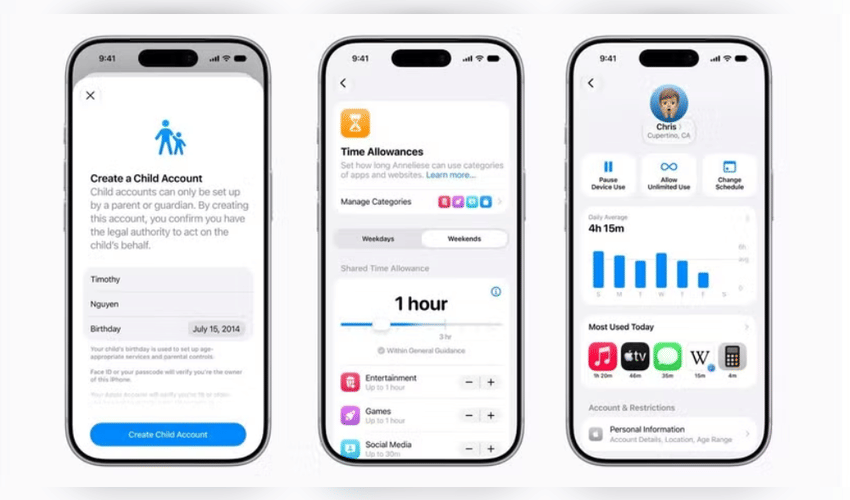

Apple opened WWDC 2026 on June 8 with one of its biggest child-safety initiatives in recent years, introducing a range of new features aimed at helping parents control what children can access online, who they can communicate with and how much time they spend on digital platforms. The move comes amid growing regulatory pressure on technology companies to better protect minors online. Recently, the European Commission questioned Meta over its ability to stop underage users from accessing Facebook and Instagram despite existing age restrictions. In response, Meta argued that app stores and operating systems should take greater responsibility for age verification and parental approvals instead of leaving each app to create its own safeguards.
Apple’s latest update reflects that shift by embedding child-safety protections directly into iOS, positioning the device itself as the primary layer of defence. At the centre of the new framework is the Child Account system, which Apple says will be mandatory for users under 13 and available for users up to 18 years old. When parents create a Child Account during device setup, age-appropriate protections are automatically activated across the device.
Instead of giving children unrestricted access to all apps, parents can begin with a limited set of essential applications selected either from Apple’s curated recommendations or manually chosen by the family. Additional apps can then be approved gradually over time. Apple is also extending parental approval features beyond app downloads. While Ask to Buy already lets parents approve App Store purchases and downloads, the company is adding a new feature called Ask to Browse. This tool requires children to obtain parental permission before visiting unfamiliar websites in Safari, giving parents more visibility into their children’s browsing activity.
The company is further tightening communication safeguards. Under the updated system, children will need parental approval before adding new contacts across Messages, FaceTime and Phone. Apple says this creates an extra layer of supervision before communication begins. Communication Safety is also being expanded. Previously focused on nudity detection, the feature will now identify graphic violence and gore in shared images and videos. Apple said these protections are enabled by default for users under 18 and operate in a privacy-preserving way through on-device processing.
Apple also introduced Time Allowances, which lets parents set limits based on app categories such as gaming, entertainment or social media rather than relying only on overall screen-time caps. The company said recommendations will be tailored to a child’s age using expert research, while still allowing parents to customise controls. Parents will also be able to create schedules determining which apps are accessible during certain times of day. For example, entertainment apps can be restricted during school hours while remaining available later in the day.
Screen Time is receiving a redesigned interface as well, with simplified controls and clearer insights into a child’s device usage. Parents will be able to quickly review average screen time, identify the most frequently used apps and make immediate adjustments when needed. The broader debate surrounding child safety online continues to focus on age verification. Most platforms still depend on self-reported birth dates, a system regulators argue is easy for children to bypass. Apple’s approach differs by tying protections to device-level Child Accounts linked to Apple ID authentication rather than relying on individual apps.
According to Tarun Pathak, research director at Counterpoint Research, child privacy emerged as one of the most important themes at WWDC 2026 apart from Apple’s AI announcements. He noted that easier access to AI-generated content has increased concerns among parents about what children can view online and how much time they spend on devices.
Pathak said Apple’s integrated safeguards strengthen parental control and could make iOS more appealing to families seeking a safer digital environment for children. Prabhu Ram, vice-president at CyberMedia Research, said Apple’s vertically integrated hardware and software ecosystem allows it to create a more seamless parental control experience than Android, where such tools often require manual setup and may vary between devices. Still, experts note that Apple’s system has limitations. The protections only work if parents actively create and manage Child Accounts, and they remain largely confined to Apple’s ecosystem. Devices running Android, gaming consoles and shared computers remain outside Apple’s reach.
Governments worldwide continue to push for stronger regulations around online child safety, with countries such as the US and Australia already exploring stricter age-verification requirements for social media access. Apple’s latest update represents one of the most comprehensive device-level child-safety initiatives introduced so far. Features such as Child Accounts, Ask to Browse, Communication Safety and Time Allowances move beyond basic screen-time monitoring toward broader digital supervision. The company’s approach does not fully solve wider concerns around age verification, social media exposure and online behaviour, which extend beyond a single operating system.
Apple is also introducing new developer tools to encourage safer app experiences for younger users. SensitiveContentAnalysis can help detect inappropriate material such as nudity or violence, PermissionKit allows parental approval for new in-app contacts, and the Declared Age Range API lets developers customise experiences based on age ranges without collecting exact birth dates. Apple’s WWDC 2026 announcement signals a major push toward making operating systems, rather than individual apps, the central layer of online child protection.
Disclaimer: This image is taken from Apple.



